Understanding Canada's CSA safety certification is a crucial step when planning to export electronic products to Canada. This guide clearly outlines its core standards and processes, incorporating the latest policy dynamics to help you enter the market efficiently and compliantly.
Friendly Reminder: CSA standards are continuously updated, and some certification requirements may vary by product category. Before making business decisions, it is recommended to refer to information officially published by the CSA Group as the final authority.
CSA stands for the Canadian Standards Association. Founded in 1919, it is a non-profit organization and one of Canada's primary safety certification bodies. Although CSA certification is often legally considered voluntary, in practice, many Canadian buyers, distributors, and even local governments regard it as a basic safety requirement. Especially in the electrical and electronic products sector, it is virtually a de facto market access requirement.
Certification Modes are primarily divided into three categories:
·Certification with Field Label: For products like household appliances.
·Component Recognition: For products that are components of other devices.
·Product Evaluation: For other electronic products not covered above.
CSA Certification Core Standards & Projects:
The CSA standard system is extensive, but the most relevant for electronic products is the C22.2 series of standards. Identifying which specific standard your product needs to comply with is the starting point for successful certification.
Core Standards Quick Reference Table:
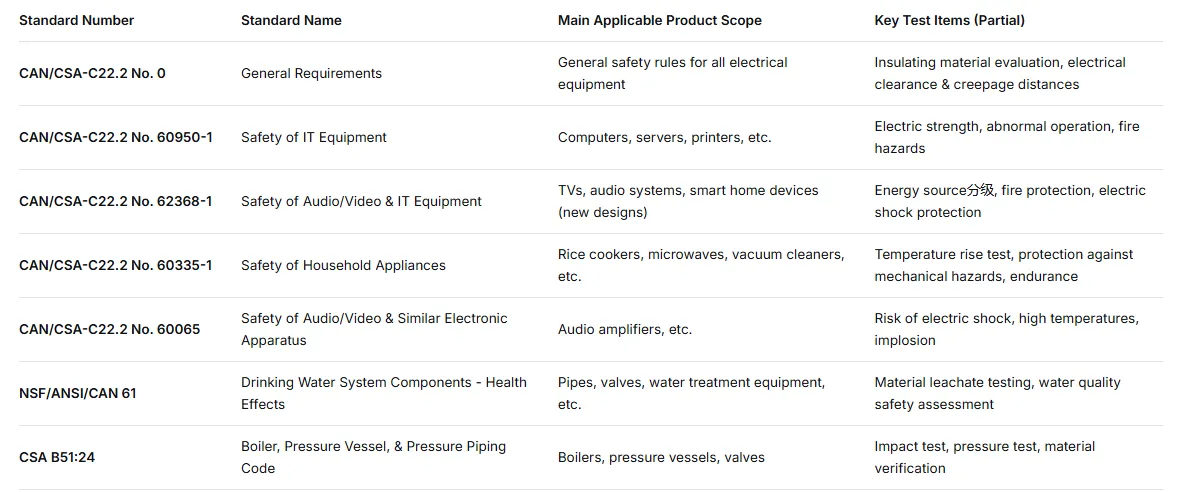
Important Notes:
·Some products, in addition to safety standards, must also comply with Natural Resources Canada's (NRCan) energy efficiency regulations and complete registration.
·If your product has wireless functions (e.g., Wi-Fi, Bluetooth), it must additionally obtain certification from Innovation, Science and Economic Development Canada (ISED) to comply with EMC and radio spectrum regulations.
CSA Certification Process in Four Steps:
1.Preparation & Application:
This is the project foundation phase. Core tasks include:
·Preparing application materials: You need electrical schematics, a Bill of Materials (BOM), product manuals, construction diagrams, etc. In the BOM, it is highly recommended to select key components that are already CSA or UL certified, as this significantly streamlines the subsequent process.
·Submitting application form & paying fees: After submitting documents to the CSA Group or a recognized laboratory, they determine the cost based on product complexity. The process officially starts upon your confirmation and payment.
2.Sample Testing & Reporting:
This is the technical core of certification.
·Sending samples: Send test samples to the designated laboratory.
·Laboratory testing: The lab conducts rigorous testing according to the applicable C22.2 standard, including but not limited to electric strength, insulation resistance, temperature rise, and fault condition analysis.
·Issuing preliminary report: After testing, you receive a preliminary report detailing compliance or required improvements.
2.Factory Audit (if required):
For some higher-risk products, CSA may require an Initial Factory Evaluation (IFE) to audit the production quality system.
3.Certification Issuance & Ongoing Surveillance:
This is the phase for obtaining and maintaining the certificate.
·Signing service agreement: You need to sign a service agreement with CSA, consenting to subsequent follow-up inspections.
·Issuing certificate: Upon passing all stages, CSA issues the certification certificate, authorizing the use of the CSA mark on your product.
·Regular factory inspections: After certification, CSA conducts periodic factory audits to ensure ongoing compliance. You need to pay corresponding annual fees for this.
2025 Updates & Practical Advice:
·Pressure Vessel Impact Test New Requirement: The CSA B51:24 standard introduces mandatory impact testing requirements for carbon steel pressure vessels. Relevant manufacturers must ensure their products comply.
·Cybersecurity New Frontier: For connected devices, particularly smart appliances, attention should be paid to emerging cybersecurity standards.
Navigating the Process:
1.Clarify the "Voluntary" vs "Mandatory" Misconception: Explain that while CSA is "voluntary," due to widespread market requirements (from buyers, e-commerce platforms, insurers), it acts as a de facto market access barrier.
2.Emphasize "One Test, Multiple Market" Value: The CSA Group is recognized by OSHA as a Nationally Recognized Testing Laboratory (NRTL). Therefore, one test might yield both the CSA mark and the CSA NRTL/cULus mark, facilitating entry into both Canada and the US markets – a significant advantage.
3.Stay Informed on Cybersecurity: For connected devices, note that cybersecurity is becoming a new global regulatory focus.
We hope this overview of Canada CSA certification assists you. If you need to explore more details for specific product categories, feel free to contact BLUEASIA at +86 13534225140 for professional certification consulting services.
相关新闻