The Saudi Standards, Metrology and Quality Organization (SASO) has introduced a series of new regulations for import product conformity certification. These changes will directly impact whether your products can smoothly enter the Saudi market.
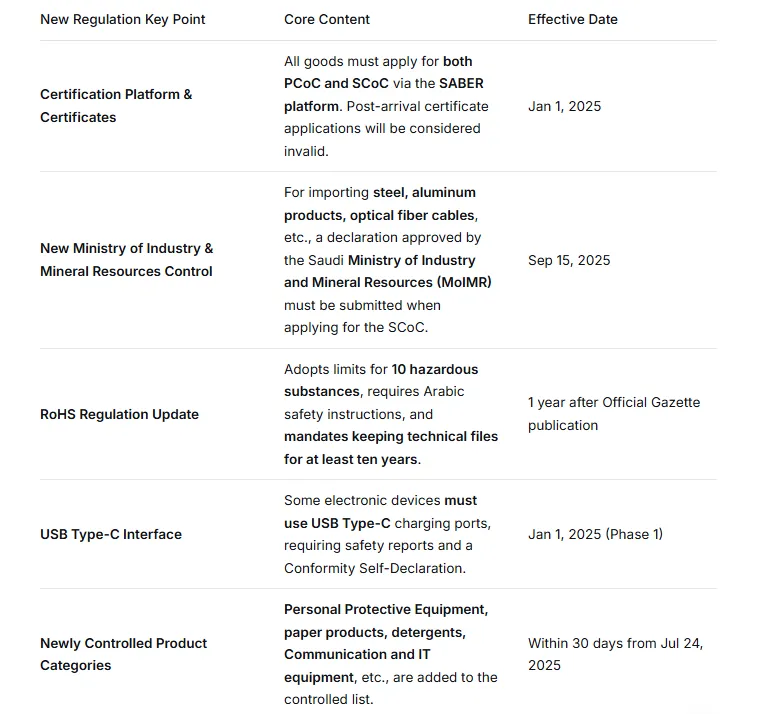
Detailed Explanation of New Regulations & Response:
Let's delve deeper into the specifics and important details of these new regulations.
1.SABER Platform & Dual Certificate System:
·PCoC Certificate: This is the prerequisite for product market access, proving your product complies with Saudi technical regulations. It's applied for by the importer on the SABER platform and is valid for one year. Test reports and technical documents are required.
·SCoC Certificate: This is the key for customs clearance, proving the shipment matches the PCoC description. Each shipment requires a separate application, and it must be completed before the goods arrive at the Saudi port. Note: SABER connects with Saudi Customs' FASAH system; the SCoC is verified electronically automatically; printing is not required.
2.Special Requirements for Specific Products:
·MoIMR Controlled Products: For steel products, aluminum products, optical fiber cables, etc., in addition to the standard SABER certification, importers must prepare an additional Arabic declaration and obtain prior approval from the Saudi Ministry of Industry and Mineral Resources (MoIMR). This approved declaration with a QR code is a mandatory document for the SCoC application.
·Newly Controlled Products: Within 30 days starting July 24, 2025, Personal Protective Equipment, paper products, detergents, and Communication & IT equipment must also comply with relevant technical regulations and obtain PCoC and SCoC certificates via SABER.
3.Environmental & Compatibility Requirements for Electronic Equipment:
·Updated RoHS Regulations: Saudi Arabia is revising its RoHS regulations, planning to restrict 10 hazardous substances. Additionally, the regulations emphasize requirements for Arabic manuals and labels, and mandate that manufacturers, importers, and distributors keep technical documentation and Declarations of Conformity for at least ten years.
·Unified Charging Interface: To reduce e-waste, Saudi Arabia has begun phasing in the mandatory use of USB Type-C. Phase 1 (starting Jan 1, 2025) covers phones, tablets, headphones, etc.; Phase 2 (starting Apr 1, 2026) extends to laptops. Relevant products need to submit test reports for the IEC 62368-1 safety standard and a Conformity Self-Declaration for charging port performance.
Here are some practical suggestions to ensure your goods clear customs smoothly:
1.Plan and Apply Early: Initiate the PCoC certification process well in advance, allowing ample time for testing and document preparation. Crucially, the SCoC certificate must be applied for after shipment but before the goods arrive at the port. Failure to do so will prevent customs clearance and may incur high demurrage charges.
2.Ensure Document Compliance: All submitted technical documents, especially user manuals and safety warnings, must have professional Arabic translations. Product labels also need to include Arabic information.
3.Leverage Professional Expertise: The SASO certification process involves numerous technical details and paperwork. It's highly recommended to work with a SASO-approved Conformity Assessment Body (CB). They are familiar with the latest regulations and platform operations, helping you navigate risks and improve certification success rates.
We hope this overview of the new Saudi SASO regulations helps you better plan and execute your export operations. If you have more detailed questions about certification standards for specific products, BLUEASIA is happy to provide further information. BLUEASIA: +86 13534225140, will provide you with professional certification consulting services!
相关新闻

