According to the latest information released in 2025, the HDMI 2.2 specification introduces a series of important new regulations, mainly focusing on significant performance improvements and updates to certification requirements. The table below summarizes the core new regulation points to help you quickly grasp the changes.
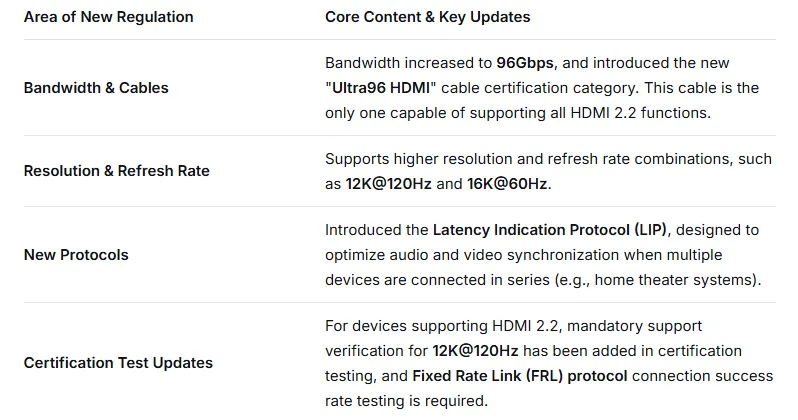
Detailed Explanation of HDMI 2.2 Certification New Regulations for Cables:
The HDMI 2.2 specification imposes clear and mandatory new requirements for cables.
1.Ultra96 HDMI Cable Becomes a Mandatory Certification Item: With bandwidth soaring to 96Gbps, existing high-speed cables can no longer meet the demand. Therefore, the new regulations introduce the "Ultra96 HDMI Cable" as a全新认证类别. All products claiming to support HDMI 2.2 functions must use this certified Ultra96 cable to ensure performance.
2.Clear Certification Label: Like the previous Ultra High Speed cables, the Ultra96 HDMI Cable is part of the HDMI Cable Certification Program, requiring each model by length to be tested and certified, and display the certification label on the packaging for easy consumer identification.
3.Release Date: The new Ultra96 HDMI Cable is expected to be available in Q4 2025.
HDMI 2.2 Device Certification & Test Updates:
For devices supporting HDMI 2.2, certification test items have also been updated synchronously, raising the threshold.
1.New Mandatory Test Items: When applying for certification, devices must pass special tests targeting HDMI 2.2 features, in addition to常规测试. This includes support verification for the 12K@120Hz ultra-high resolution and refresh rate, and testing of the connection success rate for the new-generation Fixed Rate Link (FRL) protocol.
2.Use of the "Ultra96" Feature Name: The new regulations encourage manufacturers to use the "Ultra96" feature name to indicate their product supports the maximum 96Gbps bandwidth and complies with the HDMI 2.2 specification. Products advertised using this name must be paired with a certified Ultra96 HDMI Cable.
HDMI 2.2 Latency Indication Protocol (LIP):
The HDMI 2.2 version introduces new functions at the protocol level aimed at improving the user experience.
The new specification includes the Latency Indication Protocol (LIP), which is primarily used to improve audio-video synchronization when multiple devices are connected in series (e.g., home theater systems connected to AV receivers or soundbars), effectively reducing interference caused by lip-sync errors.
Mandatory Nature of HDMI Certification & Compliance Points:
Understanding the mandatory nature of HDMI certification is crucial for compliant market entry.
1.Certification Mandatory Nature Stems from Trademark Authorization: It is important to clarify that the mandatory nature of HDMI certification is not directly targeted at the interface technology itself, but stems from the right to use the HDMI trademark. Any product that wants to legally use the HDMI trademark, logo, or name must have its manufacturer be an authorized Adopter of the HDMI Forum, and the product must pass the designated compliance testing.
2.Customs Active Enforcement: The HDMI Forum cooperates with enforcement agencies including US Customs and Border Protection (CBP) to monitor imported goods. Products using the HDMI trademark without certification will be treated as infringing goods, facing detention or even destruction risks.
The core of the HDMI 2.2 new regulations lies in building the cornerstone for the next generation of high-definition multimedia transmission through 96Gbps bandwidth, mandatory Ultra96 cable certification, 12K@120Hz support, and the new LIP protocol. For manufacturers, ensuring products and cables pass the new certification is the only way to legally use the HDMI trademark and smoothly enter the market. You can consult BLUEASIA: +86 13534225140, will provide you with professional certification consulting services.
Related News