Argentina's S-Mark certification is a mandatory safety certification for electronic and electrical products entering the Argentine market, a crucial hurdle for many exporters. With the implementation of new 2025 regulations, certification requirements and cost structures have undergone significant changes.
This article provides a comprehensive analysis of the cost structure and latest requirements for Argentina's S-Mark certification, based on the latest regulations and market data.
Argentina's S-Mark certification is a mandatory product certification system established under Argentine Resolution 92/98, regulated by the Argentine Institute for Standardization and Certification (IRAM).
It applies to most electronic and electrical products operating in the range of 50-1000 volts AC or 50-1500 volts DC.
The core purpose of S-Mark certification is to ensure that products entering the Argentine market comply with local safety standards and regulations, protecting consumer safety.
Notably, Argentina is a member of the CB Scheme, meaning CB certificates and test reports can be recognized during the certification process, helping to reduce duplicate testing.
Detailed Breakdown of Argentina S-Mark Certification Costs:
The total cost for Argentina S-Mark certification typically ranges between $3,000 and $15,000 USD (approximately RMB 20,000 to 100,000), depending specifically on product complexity and certification mode.
1. Cost Overview by Product Type:
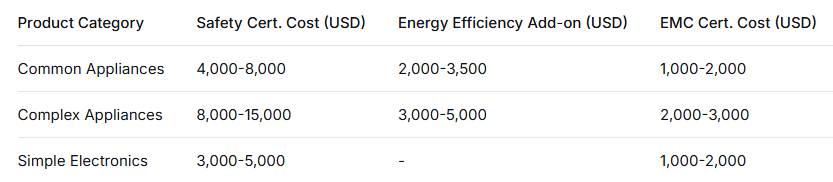
2. Cost structure primarily includes the following components:
·Safety Testing Fees: Vary from $3,000-$10,000 USD based on product type and test standards. Complex products like major appliances (refrigerators, washing machines) have higher testing fees, while simpler products like power adapters have relatively lower costs.
·Factory Audit Fees: If the Mark of Conformity certification mode is chosen, initial factory audits and annual surveillance audits are required, costing $1,000-$3,000 USD per audit.
·EMC Testing Fees: For electronic and electrical products, the Argentine National Communications Agency (ENACOM) requires Electromagnetic Compatibility testing, costing approximately RMB 10,000-30,000.
·Energy Efficiency Testing Fees: For high-energy-consumption products like air conditioners and refrigerators, additional energy efficiency certification is required, costing approximately $2,000-$5,000 USD.
·Certificate Maintenance Annual Fee: An annual maintenance fee is required after certification is obtained; the specific amount varies by certification body.
Key Factors Influencing Argentina S-Mark Certification Costs:
Product complexity is the primary factor affecting certification costs. Technically complex products (e.g., air conditioners, microwaves) require more test items and man-hours, leading to higher fees.
The choice of certification mode also directly impacts cost:
·Type Certification: Requires only product testing + document review, no factory inspection, resulting in lower costs.
·Mark of Conformity Certification: Requires product testing + initial factory inspection + post-certification surveillance, resulting in higher costs.
Different certification bodies approved by IRAM, including international bodies like TÜV SÜD, have varying fee schedules.
Furthermore, utilizing CB report conversion is key to reducing costs. Holding valid CB certificates and test reports can avoid duplicate testing, saving on some expenses.
2025 Argentina S-Mark Certification New Regulations & Mark Requirements:
Argentina's S-Mark certification saw important updates in 2025. The mandatory enforcement date for the new version of the conformity mark, originally scheduled for March 28, 2025, has been postponed to October 1, 2025.
After this date, all products must use the new conformity mark.
Core requirements for the new mark include:
·The mark must be placed in a visible location on the product or its primary packaging.
·The mark must be indelible and permanently affixed under reasonably foreseeable conditions of use.
·The new conformity mark includes a QR code; scanning it should link the user to the Spanish version of the Declaration of Conformity.
·According to the resolution, the manufacturer, importer, or authorized Argentine agent must sign the Spanish Declaration of Conformity based on the product's valid certificate.
·This declaration ensures the product complies with applicable technical regulations, and its information must be accessible via the QR code.
Conclusion:
The final cost of Argentina S-Mark certification ultimately depends on the product's complexity and the chosen certification mode. For companies planning long-term entry into the Argentine market, choosing the Mark of Conformity mode and utilizing CB report conversion, while involving higher upfront investment, is more economical in the long run.
Whether choosing Type Certification or Mark of Conformity Certification, preparing CB reports and Spanish documents in advance are key strategies for optimizing costs and improving efficiency. BLUEASIA: +86 13534225140 will provide you with professional certification consulting services
Related News