For manufacturers planning to export to the EU, "How much does CE-EMC certification cost?" is a critical question with no single answer. Blindly seeking the lowest price can lead to invalid certificates and seized products, while not understanding cost drivers can blow your budget. In 2025, with stricter EU market surveillance and evolving standards, mastering the real logic behind certification costs is more crucial than ever.
The total cost of CE-EMC certification isn't a flat fee but depends on product type, complexity, and required directives. The table below summarizes typical 2025 cost ranges for mainstream product categories to help you establish a budget baseline.
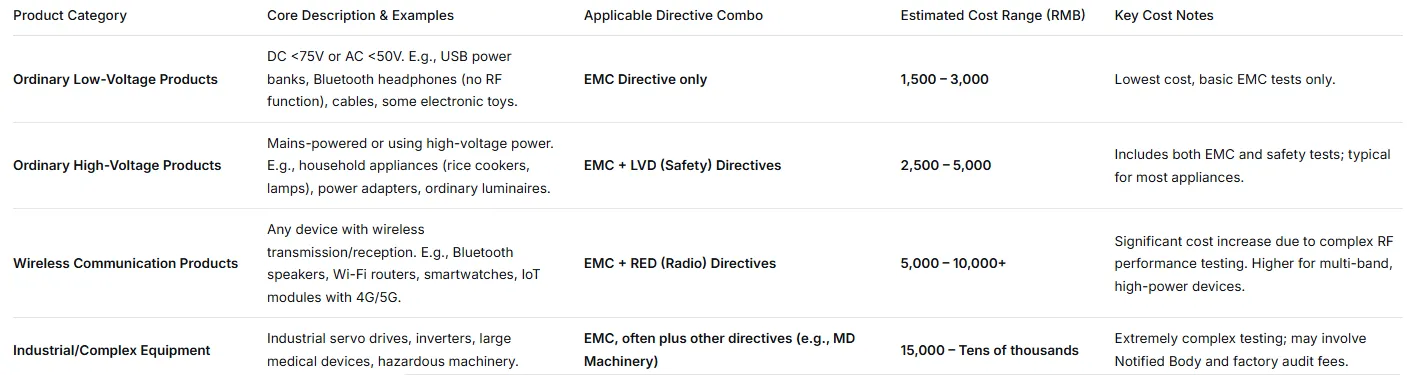
Important Note: These are market reference ranges. Actual quotes depend on specific technical parameters. A Bluetooth headset certification could range from 3,000 to 8,000 RMB based on chipset and bands.
II. Cost Composition & Influencing Factors: Where Does the Money Go?
Certification costs are like an iceberg; the quoted price is just the tip.
1.Core Cost Components:
-Base Testing Fee: The largest portion (60%-80%). Labs charge per test item or package for required EMI/EMS tests (e.g., RE, CE, ESD, Surge).
-Technical File Service Fee: For compiling EU-compliant documentation (circuit diagrams, manuals, risk assessments). Typically 1,000-5,000 RMB if outsourced.
-Certificate & Review Fee: For certificate issuance by the certification body. Lower or included in testing fees for products not requiring a Notified Body.
2.The Biggest "Variable Cost": Rectification & Retesting
This is the most unpredictable budget item. If initial testing fails, costs for design optimization (shielding, filters), new samples, and retesting can easily multiply the initial test fee, reaching 10,000 to 100,000 RMB. This is why "pre-compliance testing" is strongly advised.
3.Key Factors Influencing Total Price:
-Product Risk Level & Certification Path: The core factor. Most ordinary electronics can use the "Self-Declaration" path (lower cost). High-risk products like medical devices require mandatory certification by an EU Notified Body (significantly higher cost and complexity).
-Lab/Certification Body Brand & Accreditation: Premium international bodies (e.g., TÜV, Intertek) can be 30%-50% more expensive than competent domestic labs.
-Additional Service Needs:Expedited service (shorter timeline) may add 20%-30%. Factory audits (for high-risk products) can cost 5,000+ RMB per visit. Some bodies charge annual maintenance fees for high-risk product certificates.
III.Is Certification a One-Time Expense?
CE certification is not a permanent "stamp." Its validity is dynamic, contingent on two factors:
1.The Product Remains Unchanged: Any modification affecting EMC characteristics (design, components, structure) requires re-assessment.
2.Standards Remain Current: EU harmonized standards update roughly every 5 years. Once a new version is enforced, Declarations of Conformity based on the old standard become invalid, potentially requiring re-testing.
Therefore, treat certification as ongoing compliance management within the product lifecycle, and budget/plan for potential standard updates.
In summary, CE-EMC certification cost is a strategic, technical investment. It's not just a market entry ticket but a reflection of product quality and compliance capability.
BLUEASIA Tech: +86 13534225140 provides professional certification consulting services.
Related News