Below is a detailed introduction to the process and timeline for Canada's IC mandatory certification, updated with the latest information for your reference.
·Canada IC certification (now managed by ISED) is a mandatory compliance scheme for electrical and electronic products entering the Canadian market. It primarily ensures products meet
·Canada's Electromagnetic Compatibility (EMC) and radio communication regulations, preventing devices from causing harmful interference to the local radio spectrum.
Important Note: ISED was formerly Industry Canada, hence the name "IC Certification".
IC Certification is primarily divided into two modes based on wireless functionality:
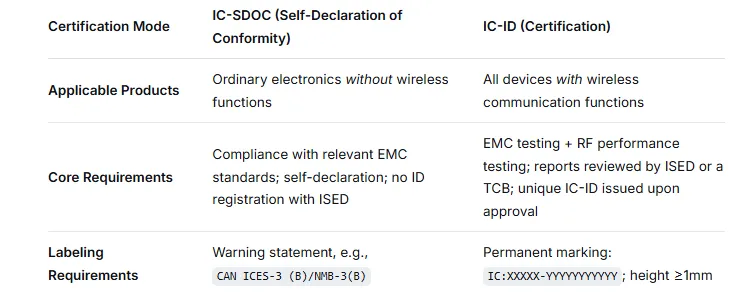
Key Steps in the IC Certification Process:
1.Preparation & Product Classification (~1-2 weeks)
This is the project foundation phase. Core tasks include:
·Confirming product category & applicable standards: Accurately determining whether the product falls under the IC-SDOC or IC-ID path and identifying the specific test standards.
·Preparing technical documentation: Such as circuit diagrams, user manuals, technical specifications, etc.
·Arranging a Canadian Local Representative: This is a mandatory requirement. For wireless products, you must provide the address and authorization letter of a Canadian local representative.
2.Sample Testing – The Core Phase
Samples must be tested at a laboratory accredited by ISED. This is the technical core of the entire certification.
·EMC Testing: Assesses the equipment's electromagnetic disturbance (conducted and radiated emissions) capabilities. This is a mandatory test item for all electronic devices.
·RF Testing (IC-ID only): Verifies key RF parameters of wireless devices, such as frequency range, output power, bandwidth, and spurious emissions.
·SAR Testing (if applicable): Specific Absorption Rate testing is required for body-worn wireless devices (e.g., mobile phones, smartwatches). This item incurs additional costs.
2.Report Review & Certification Issuance
·IC-SDOC: After successful laboratory testing, a conformity report can be issued directly. The process is relatively fast.
·IC-ID: Test reports must be submitted to a TCB (Telecommunication Certification Body) or ISED for review. The certificate is issued upon approval. This official review process is the main time-consuming component.
Certificate Maintenance: Validity & Ongoing Compliance
Regarding certificate validity, online information varies, but the most authoritative view is that ISED certification certificates are
permanently valid. However, obtaining the certificate is not a one-time effort; its validity is based on ongoing compliance. Key maintenance activities include:
·Annual Reporting: Submit sales data (including nil reports) for the previous year to ISED by January 31st each year.
·Handling Market Surveillance: Retain at least one certified sample to address potential random market spot checks by ISED. If a check fails, a corrective action plan typically needs to be submitted within one month.
·Managing Changes: Any hardware changes that could affect RF performance (e.g., modifying antenna design, replacing power amplifiers, or adjusting operating frequency bands) may require re-certification.
Optimizing Your IC Certification Strategy:
1.Leverage Existing Test Reports: IC certification test items are similar to U.S. FCC certification. Consider a joint application; some test reports may be accepted, saving cost and time.
2.Use Pre-certified Modules: For wireless products, selecting wireless modules that already possess IC-ID certification can exempt the end product from RF testing, significantly reducing testing costs and complexity.
We hope this detailed overview of the Canada IC mandatory certification process and timeline is helpful. Should you need to discuss specific aspects of the certification process in more detail, feel free to contact BLUEASIA at +86 13534225140 for professional certification consulting services
Related News

