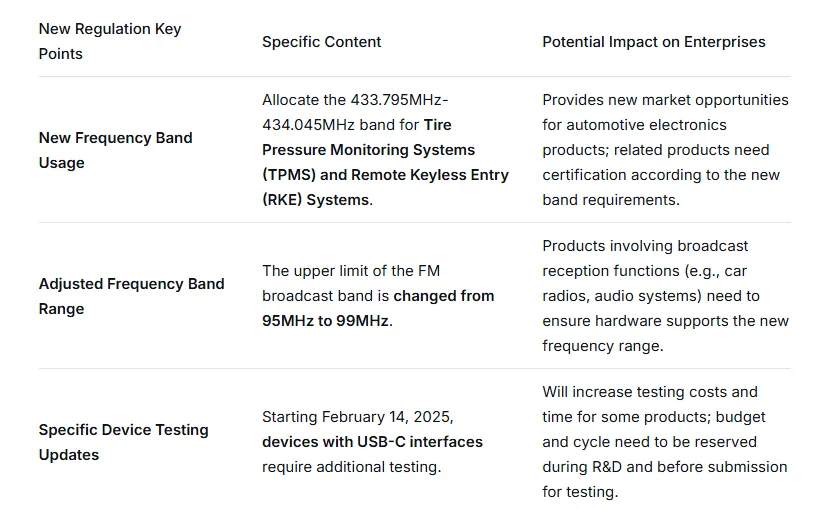
To help you quickly grasp the core new regulations, the following table summarizes the main changes to Japan TELEC certification in 2025:
Japan TELEC certification, officially known as "GITEKI Certification," is a mandatory access requirement for radio equipment implemented according to Japan's Radio Law. Its core purpose is to ensure that radio equipment produced domestically and abroad complies with Japanese technical standards and does not interfere with existing radio signals.
·Regulation and Execution: The Japanese Ministry of Internal Affairs and Communications (MIC) is the regulatory body, and the Telecom Engineering Center (TELEC) is one of the primary certification bodies authorized by MIC.
·Core Requirements: All radio equipment sold or used in the Japanese market must pass this certification. If a product is not certified, it cannot pass Japanese customs, potentially leading to product recalls and penalties for manufacturers.
Applicable Product Scope for Japan TELEC Certification:
TELEC certification covers an extremely wide range of radio equipment; generally, if your product has a wireless transmission function, it requires certification. It mainly includes the following categories:
·Short-Range Communication Devices: Such as Wi-Fi routers, Bluetooth earphones/speakers, wireless mice/keyboards, etc.
·Cellular Network Equipment: Smartphones, tablets, IoT terminals supporting 2G/3G/4G/5G, etc.
·Radio Frequency Identification (RFID) Systems: Including readers, tags in LF, HF, UHF bands, etc.
·Specialized Radio Equipment: Such as drones, radar systems, and various industrial application wireless products.
·Wireless Modules and Chips: Pre-certification of these core components can simplify the final product certification process.
Japan TELEC Certification Process and Required Materials:
Certification Process:
The TELEC certification process starts with an application and typically involves two independent parts: the testing laboratory and the certification body. The certification process usually includes the following key stages:
1.Application and Testing: Submit an application to a TELEC-accredited testing laboratory and conduct comprehensive RF and EMC tests on product samples according to Japanese standards.
2.Report Preparation: After passing the tests, the laboratory prepares a detailed test report, which is the core basis for submitting the formal certification application to TELEC.
3.Body Review and Certification Issuance: The TELEC certification body conducts a comprehensive check of the test report and related documents. After approval, the corresponding TELEC certificate is issued.
4.Product Identification: After certification, the enterprise must correctly affix or print the "GITEKI" mark and certificate number on the product to prove its compliance.
Required Materials:
Preparing complete documents is key to successfully passing certification. The materials you need to prepare mainly include:
1.Application and Compliance Documents: Technical model specification sheet, application form, power of attorney/letter of authorization.
2.Technical Construction Documents: Circuit block diagram, schematics, material list (BOM), internal and external photos.
3.Product Information Documents: Product manual, user manual (recommended to include Japanese version), operational technical descriptions.
4.Testing and Identification Documents: Antenna specifications, test report, label information (needs to specify label location and content).
Japan TELEC Certification Fees and Timeline:
TELEC certification fees vary significantly depending on product type, technical complexity, and certification mode.
1. Fee Composition:
·Testing Fee: Accounts for the largest proportion, depends on wireless technology type, number of supported bands, and transmit power. For example, a single-band Bluetooth earphone is approximately RMB 25,000 to 50,000, while a complex device supporting 5G may start from RMB 80,000, even exceeding RMB 150,000.
·Certification Service Fee: The certification body's review, administrative, and certificate issuance fees, approximately RMB 5,000 to 30,000.
·Japanese Agent Service Fee: A mandatory fee because overseas manufacturers must appoint a company registered in Japan as their representative, typically costing RMB 8,000 to 20,000 per year.
2. Certification Timeline: Under smooth testing conditions, the TELEC certification cycle is generally 4-8 weeks. However, considering the entire process of testing, modification, and review, the total cycle may extend to 2-4 months. Choosing expedited service can shorten the cycle to 6-8 weeks, but costs increase by 30%-50%.
Conclusion:
We hope this overview of Japan's TELEC new regulations provides strong support for you. If you are more interested in specific aspects of certification, such as test standards for specific products or document preparation details, we are happy to provide further information. BLUEASIA: +86 13534225140 will provide you with professional certification consulting services
Related News

