DAB+ (Digital Audio Broadcasting Plus) certification is a mandatory market access requirement for digital audio broadcasting equipment entering international markets. Its core purpose is to ensure devices comply with target market technical regulations regarding RF performance, audio quality, electromagnetic compatibility (EMC), and safety. Below is the latest certification process, timeline, and practical guidance as of November 2025.
1. Preliminary Preparation (1–2 weeks):
- Product Classification and Standard Confirmation: Identify device type (in-vehicle, home, or transmitter) and target market (e.g., EU, Middle East). Confirm applicable core standards (e.g., ETSI EN 300 401) and regional supplementary requirements (e.g., UAE.S 5021:2018).
- Technical Documentation Framework: Prepare schematics, PCB layouts, Bill of Materials (BOM), and multilingual user manuals (EU requires official languages; Middle East requires Arabic).
- Prototype Preparation: Provide 2–3 finished prototypes covering all declared models.
2. Testing Phase (4–8 weeks):
- Pre-testing (Optional but Strongly Recommended):
- Purpose: Preemptively identify design flaws to reduce formal test failure risk (pre-testing reduces formal test failure rate by 40%).
- Items: Reception sensitivity (threshold -97dBm), audio decoding latency (target ≤50ms), preliminary EMC scan.
- Duration: 2–4 weeks (includes lab scheduling, testing, and iteration).
- Formal Testing:
- RF Performance: Receiver sensitivity (must ≤ -85dBm), frequency stability (±1ppm), adjacent channel selectivity.
- Audio Quality: HE-AAC v2 decoding compatibility (using 128kbit/s source), dynamic range (≥70dB).
- EMC Testing: Radiated emissions and immunity (per EN 301 489).
- Specialized Testing (if applicable):
- In-vehicle devices: Vibration testing, temperature cycling (-40°C to 85°C).
- Smart devices: IPv6 protocol testing (RFC8200, mandatory in EU by 2025).
3. Review and Certification (2–4 weeks):
- Document review: Certification bodies (e.g., EU Notified Bodies, Middle East TDRA) verify consistency of test reports and technical documentation.
- Common rejection reasons: Incomplete frequency band coverage, user manuals lacking DAB+ feature descriptions or local language support.
-Certificate Issuance: Upon approval, issue type approval certificates (e.g., CE-RED certificate or Middle East TDRA certificate).
II. DAB+ Certification Timeline & Optimization:
1. Full Cycle Analysis:
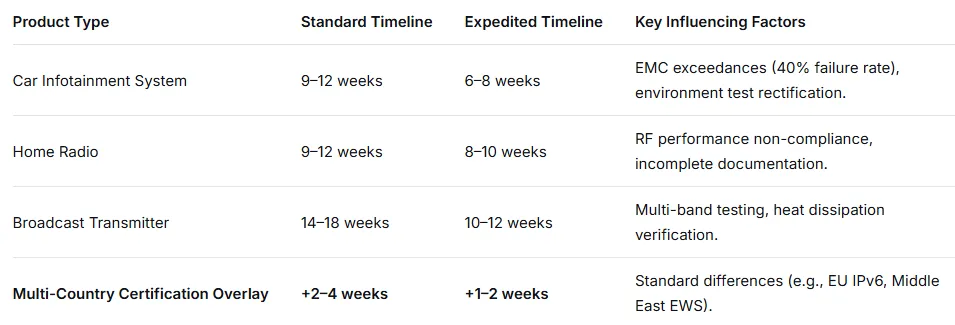
2. Cycle Optimization Strategies:
- Modular Design: Utilize pre-certified DAB+ chipsets (e.g., NXP TEF7000) to reduce testing workload by 50%.
- Pre-Testing Services: Invest upfront costs (1/3 of formal testing fees) to avoid cycle extensions caused by rectifications.
- Parallel Documentation Preparation: Simultaneously draft technical documents during testing to shorten review time.
- Expedited Channel: Pay 30%-50% expedited fee to compress cycle to 60% of standard duration.
III. Key New Regulations & Regional Differences (Updated 2025):
1. EU:
- Mandatory addition of IPv6 protocol testing (RFC8200); non-pre-adapted devices face 1–2 week cycle extension.
- CE certificates remain valid indefinitely but require ongoing compliance with regulatory updates (e.g., revised RED Directive).
2. Middle East:
- Saudi Arabia: Certificates valid for 2 years; in-vehicle devices must support Emergency Warning System (EWS) and Arabic interface.
- UAE: TDRA certification fees 15%-30% higher than EU; requires designated local agent.
3. Southeast Asia:
- Thailand's NBTC standards become mandatory; new in-vehicle devices require certification starting October 31, 2025.
DAB+ certification serves as the “technical passport” for device globalization. Enterprises must implement forward-looking planning (embedding IPv6/EWS functionality), precise testing (avoiding EMC pitfalls), and localized collaboration (agents/laboratories). As mandatory requirements for in-vehicle devices deepen in 2025, systematic compliance strategies will become a core competitive advantage for market access.
This information is current as of November 2025, based on the latest developments from ETSI, WorldDAB, and the EU Official Journal. For specific implementation, follow guidance from authorized laboratories (e.g., Blue Asia Testing: +86 13534225140).
相关新闻