In 2025, the "underlying logic" of FCC ID certification has changed. Laboratory eligibility and adaptation to new rules have become compliance prerequisites more critical than the process itself. This guide helps you avoid 90% of new rule pitfalls from four dimensions—front-loaded risk screening, new rule-adapted testing, full-process control, and long-term compliance maintenance—while precisely managing the certification timeline and cost.
The FCC 25-27 Equipment Authorization Security Final Rules, effective September 8, 2025, are the "make-or-break" line for this year's certification. All companies must first verify laboratory eligibility before initiating the certification process.
1. Three Mandatory Verification Points for Laboratory Eligibility (All are essential)
The FCC 25-27 new rules explicitly prohibit laboratories controlled by or affiliated with foreign adversary entities. Companies must verify lab compliance from these dimensions:
-Ownership Disclosure: Require the lab to provide information on shareholders with ≥5% ownership, confirming no ownership by entities on the "Covered List" (e.g., Huawei, ZTE affiliates) or "Entity List."
-Accreditation: The lab must possess FCC-recognized testing qualifications and not be listed on the FCC's "Unacceptable Laboratory List."
-Compliance Declaration: Require the lab to issue an *FCC 25-27 Compliance Commitment Letter*, affirming it is not controlled by foreign governments or risk entities.
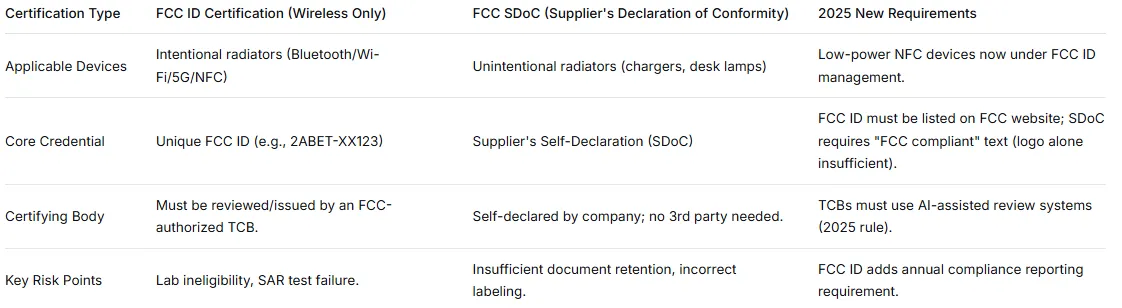
2. Core Distinction Between FCC ID and SDoC (No Gray Area in 2025)
Some companies still confuse the two, leading to compliance failure. Below are the officially defined boundaries for 2025:
II. Full 2025 FCC ID Certification Process:
The official process adds a "Post-Certification Maintenance" step to the traditional 5-step flow. Each step must incorporate new rule requirements. Below is the practical workflow with timelines and pitfalls.
Step 1: Pre-application — FRN Registration + Lab Compliance Check (1-3 business days)
Official Requirements:
1.First, register for a free FRN on the FCC website, then apply for a 3-5 digit Grantee Code (requires $60 fee, approved in ~3 business days). These are foundational identity credentials.
2.Verify lab eligibility (the 3 points above) and sign a service agreement including "compliance joint liability" to avoid certification invalidation due to lab issues.
Pitfall: In 2025, 3 companies had applications rejected due to expired Grantee Codes, requiring re-filing and fee payment, wasting 5+ business days.
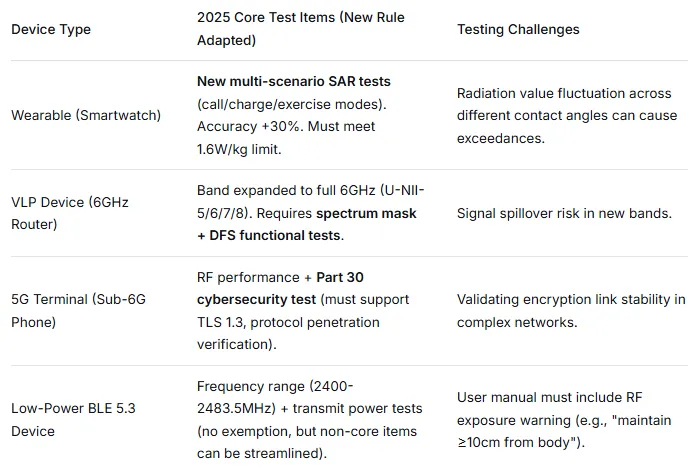
Step 2: Test Plan Development — Adapting to 3 Major 2025 Tech Rules (3-7 days)
2025 test items vary significantly by device type. Core changes focus on SAR accuracy, VLP bands, and 5G cybersecurity. There are no "test exemption" channels, though items can be adjusted based on power.
Step 3: Laboratory Testing — Complete Full Validation per New Rules (5 days - 2 weeks)
Official Mandates:
1.Testing must be completed at a compliant lab. Core standards: 47 CFR Part 15 (civilian wireless), Part 22/24/27 (5G), Part 90 (commercial wireless).
2.Test reports must be in AI-review adapted format (2025 TCB requirement), e.g., standardized templates for RF data, multi-scenario charts for SAR.
Time Cost: Low-power BLE: 5-7 days. 5G device: ~2 weeks. Rectification adds 1-2 weeks (SAR test failure rate is 28% in 2025, the top rejection reason).
Step 4: TCB Review — AI-Assisted Acceleration (Standard: 4-6 weeks, Expedited: 3-5 weeks)
In 2025, the FCC does not grade TCBs but requires AI-assisted review systems for efficiency. Review focuses on:
1.Document Compliance: User manual must show FCC ID, RF parameters, SAR warnings. Circuit diagrams need component compliance statements.
2.Test Data: Complete multi-scenario SAR data. 5G devices need Part 30 cybersecurity verification report.
3.Expedited Service: Requires 30%-50% extra fee, only for low-power devices. Complex devices (5G, etc.) do not qualify.
Pitfall Case: In Nov 2025, a smart speaker maker had submissions rejected twice due to missing RF warning in the manual, wasting 3 weeks.
Step 5: FCC Listing & Labeling (1-3 business days)
1.Listing: After TCB approval, info is auto-submitted to the FCC database. Company can query the ID on FCC ID Database; no manual filing needed.
2.Labeling: 2025 rules require FCC ID character height ≥5mm. For small devices (e.g., earbuds), it can be in the manual, but packaging must display it prominently. No special characters in the code format.
Step 6: Post-Certification Maintenance — 10-Year Document Retention + Annual Compliance (Ongoing)
This is a new, core compliance component in 2025. Non-compliance leads directly to certificate invalidation.
1.Document Retention: Test reports, circuit diagrams, antenna specs, compliance declarations must be kept for at least 10 years (previously 5). FCC can audit anytime.
2.Change Management: Changes to RF modules or software version require a "Class 2 permissive change" application. Hardware changes require a new FCC ID application.
3.Annual Reporting: Must submit an annual compliance report to the TCB, including production volume, periodic test data, quality control measures. Non-submission leads to regulatory listing.
III. 2025 FCC ID Certification Timeline & Cost: Realistic Expectations (No "Ultra-Short" Cycle Bonanza)
Market claims of "2-week certification" are extreme expedited cases. Below are 2025 industry norms. Expedited service has clear limits.
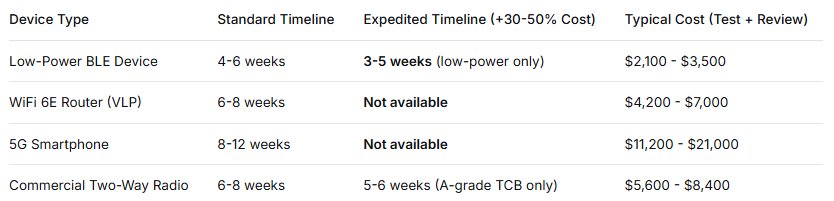
Key Reminder: Expedited service is only for low-power devices and requires both lab and TCB "green channel" coordination. Less than 15% of companies achieved 3-week expedited in 2025.
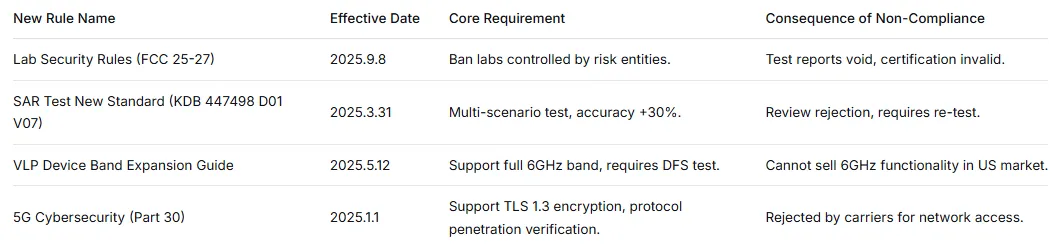
IV. Effective Dates & Mandatory Impact of 3 Core 2025 New Rules
All new rules have explicit Effective dates. Non-adaptation leads directly to certification failure.
If you are advancing FCC ID certification for a specific device type (e.g., smart wearables, 5G modules), please specify the model, and I can help match the latest 2025 test item checklist and compliant lab screening criteria. BLUEASIA: +86 13534225140 will provide professional certification consulting services.
相关新闻

