On August 7 of this year, the FCC released new security rules for its Equipment Authorization Program (FCC 25-27), which officially took effect on September 8. For the first time, these rules make a testing laboratory's ownership background and security trustworthiness a prerequisite for participation in FCC certification.
The core of the new rules is the establishment of a "trustworthiness review" mechanism designed to exclude testing bodies deemed to pose potential national security risks.
This shift marks a move in FCC certification's focus from purely assessing technical competence to a new phase that equally weighs technical capability and supply chain security.
FCC certification has always been a mandatory pass for electronic products entering the U.S. market. Previously, the FCC focused primarily on a laboratory's technical competence and impartiality. Now, the foundation of the certification rules has fundamentally changed.
The new rules took full effect on September 8, 2025, with some provisions having an enforcement grace period. For instance, laboratory accreditation bodies had until October 6 to complete required filings, while all Telecommunication Certification Bodies (TCBs) and testing laboratories must clearly list any entity holding 5% or more ownership in their organization by December 5.
The rules explicitly state that the FCC will no longer recognize testing laboratories, certification bodies, or laboratory accreditation organizations that are owned, controlled, or directed by "covered" entities.
The scope of "covered" entities is broad, including companies on the FCC's "Covered List" (e.g., Huawei, ZTE affiliates), the U.S. Department of Commerce's "Entity List," "Military End-User List," and the "NS-CMIC List" (Chinese Military-Industrial Complex Companies).
Even governments and entities from foreign adversary countries (e.g., China, Russia) are within the restricted scope.
II. FCC ID Certification Review "Red Lines":
Understanding the ownership "red lines" in the new rules is the first step for companies to avoid compliance risks. The FCC has set clear standards for defining ownership and control.
Under the new rules, any laboratory directly or indirectly owned 10% or more (in equity or voting rights) by a "covered" entity will be considered a "controlled" laboratory and barred from participating in the FCC's equipment authorization program.
This means that even a laboratory with excellent technical capabilities will immediately lose its eligibility to provide testing services for FCC certification if its ownership structure touches this red line.
More strictly, laboratories must submit declarations to the FCC within set timeframes, not only proving they are not controlled by "covered" entities but also reporting any entity holding 5% or more ownership. Laboratories that fail to provide accurate information or submit false declarations will also face loss of accreditation.
III. Panoramic View of the 2025 FCC Certification New Rules:
The 2025 FCC new rules represent more than just an upgrade in laboratory security review; they are a comprehensive set of updates covering multiple technical areas. The table below outlines the main changes and their impacts:
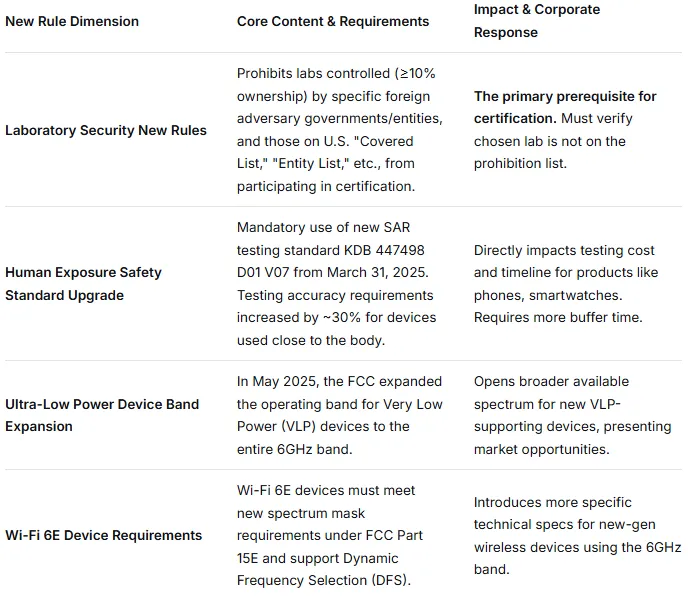
Beyond these changes, the FCC is also strengthening cybersecurity reviews for 5G devices, requiring them to pass the FCC Part 30 cybersecurity protocol review.
IV. Corporate Response Strategies:
Companies that proactively adjust their strategies will maintain a competitive edge in this new environment. Prudently selecting a testing laboratory is now the core prerequisite for certification work.
1.Companies should confirm with laboratories that they are not on the FCC's prohibition list and can request a formal declaration of compliance with the new rules. Partnering with reputable third-party certification bodies to obtain their recommended lists of compliant labs is another way to mitigate risk.
2.Building compliance into the product design phase effectively reduces later-stage rectification costs and risks. Examples include optimizing PCB layout to reduce harmonic interference or using UL-certified cables and housing materials.
3.For complex products, conducting pre-tests or GAP analysis in advance is crucial. Industry experience suggests about 80% of products require design modifications during formal testing. Pre-testing identifies issues early, avoiding delays and extra costs from formal test failures.
4.Post-certification, companies must retain all technical documents and test reports for at least 10 years for potential FCC market surveillance audits. Simultaneously, closely monitor ongoing updates to FCC technical standards, such as new spectrum mask requirements for Wi-Fi 6E devices.
The impact of the new rules is creating ripple effects through the supply chain. The industry anticipates that fees for using compliant overseas laboratories may be 30%-50% higher than before. Regarding certification timelines, with the adoption of AI-assisted review systems, TCB review cycles have the potential to shorten from the traditional 4-8 weeks to 3-5 weeks. BLUEASIA: +86 13534225140 will provide you with professional certification consulting services
相关新闻