The cost of Brazil's INMETRO energy efficiency certification varies significantly depending on product type, testing complexity, and other factors. The table below provides estimated certification costs for different product categories in 2025, giving you a general overview.
INMETRO Energy Efficiency Product Mandatory Certification Costs:
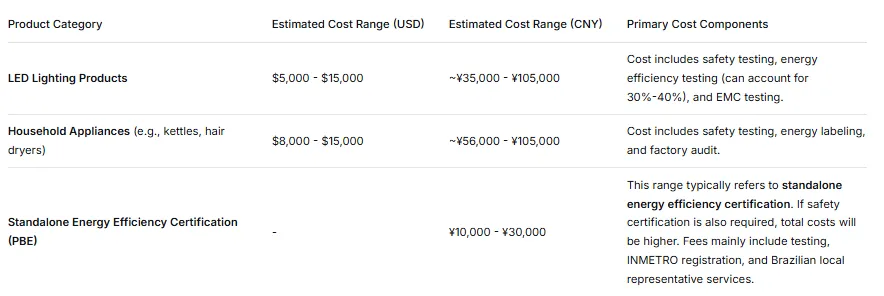
Detailed Breakdown of INMETRO Certification Costs:
The total cost of INMETRO certification is the sum of several parts. Understanding its composition aids in more accurate budgeting.
1.Product Testing Fees: This is the core cost component. Testing must be performed in locally accredited laboratories in Brazil. Prices vary based on product complexity and number of test items. For example, safety and energy efficiency testing for common appliances can range from $3,000-$8,000, while complex items like auto parts or energy storage batteries can cost $10,000-$40,000.
2.Factory Audit Fees: For high-risk products, an initial factory audit is mandatory, typically costing between $2,000-$15,000. Subsequently, annual surveillance audit fees of $1,000-$8,000 are required to maintain certificate validity.
3.Administrative & Agent Fees: This includes the application/registration fee paid to INMETRO (approx. $500-$1,500). Crucially, non-Brazilian companies must hire a Brazilian Local Representative, with annual fees around $2,000-$5,000. Additionally, there is an annual certificate fee (approx. $500-$2,000/year) to maintain validity.
4.Other Potential Costs: There are other essential, smaller costs, such as translating all technical documents into Portuguese (approx. $1,000-$3,000) and international shipping of samples to Brazil (approx. $500-$2,000). Failed tests may lead to retesting costs of 50%-100% of the original test fee.
⚠️ Important Notes:
1.Mandatory Requirement: INMETRO certification is a mandatory market access requirement for product sales in Brazil. Non-compliant products cannot clear customs and risk detention, high fines (reportedly up to 50% of goods value), or even criminal penalties.
2.Local Representative & Language: Non-Brazilian companies must apply through a Brazilian local importer or agent as the legal representative. All technical documents, labels, and manuals must be in Portuguese.
3.Comprehensive Decision-Making: Cost is just one factor when choosing a partner. We recommend evaluating their professional capability, local service network in Brazil, and experience with specific product categories.
We hope this detailed cost analysis and process explanation helps you better plan your market entry into Brazil. If you can share more specific product information, BLUEASIA might provide more targeted standard references.
BLUEASIA: +86 13534225140, provides professional certification consulting services!
Related News