Here is a detailed introduction to the standards and projects under Canada's IC mandatory certification, organized and updated to provide a unique and informative perspective.
The technical requirements for Canada IC certification primarily revolve around two core areas: Electromagnetic Compatibility (EMC) and Radio Frequency (RF) Spectrum compliance. The specific technical requirements are defined by a series of standards, mainly categorized into the ICES series and RSS series.
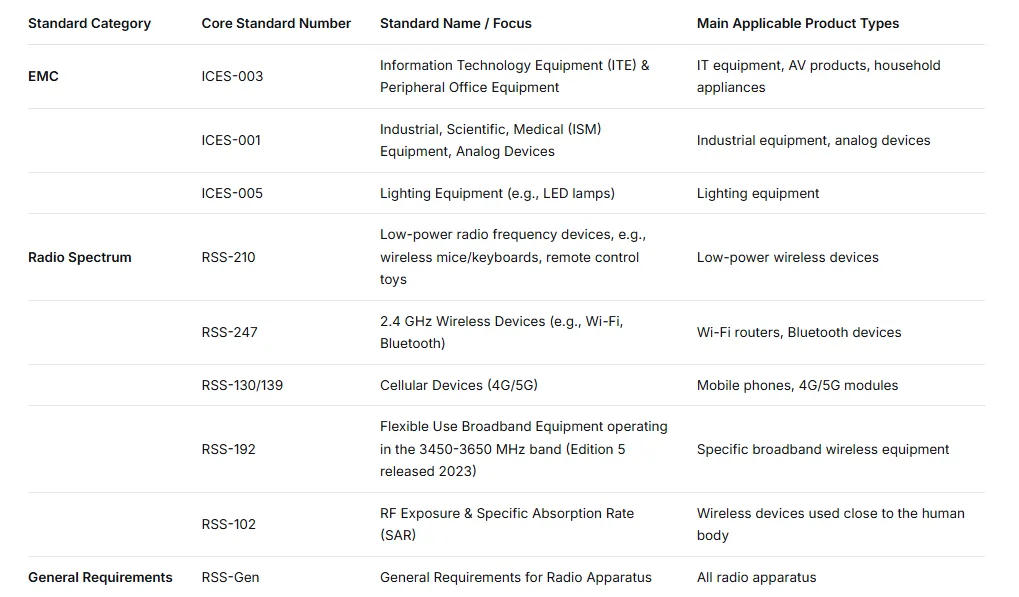
Detailed Key Test Projects:
Based on the standards above, the main test projects involved in Canada IC certification are as follows:
1.EMC Testing:
Ensures that electromagnetic disturbances generated by the device during operation are within limits and that the device has a certain level of immunity. Key tests include:
·Radiated Emissions: Measures electromagnetic disturbances propagated through space.
·Conducted Emissions: Measures electromagnetic disturbances transmitted via power or signal lines.
2.RF Testing:
This is the core test project for wireless devices (IC-ID certification), ensuring their RF parameters comply with Canadian regulations:
·Frequency Range & Transmitter Power: Verifies the device's operating bands and output power comply with the relevant RSS standard.
·Spectrum Mask or Occupied Bandwidth: Ensures the device's transmitted signal remains within its assigned bandwidth and that out-of-band emissions do not exceed limits.
·Spurious Emissions: Detects unwanted RF signals generated by the device outside its operating band(s).
3.Specific Absorption Rate (SAR) Testing:
·For wireless devices used close to the human body (e.g., mobile phones, tablets), this assesses the rate at which RF energy is absorbed by the body to ensure compliance with safety limits. This test typically references RSS-102.
2025 New Regulations & Standard Update Trends:
When planning certification, please pay close attention to the following latest developments:
1.Series Model Certification New Rule: Effective June 30, 2025, multiple Product Marketing Names (PMNs) for a single hardware model cannot be listed in a single field separated by commas or slashes. "Series Certification" mode must be used, requiring separate submissions of data for each "hardware + market name" combination.
2.Ongoing Standard Updates: ISED technical specifications are continuously updated. For example, Edition 5 of RSS-192 became mandatory on January 5, 2024, expanding the upper-frequency range and modifying output power requirements for some devices. Always check the latest effective version of the applicable standard.
Based on whether the product has wireless functionality, Canada IC certification is mainly divided into two paths:
·IC-SDOC (Self-Declaration of Conformity): For ordinary electronics without wireless functions. The core is compliance with relevant EMC standards (e.g., ICES-003); no need to register an ID with ISED.
·IC-ID (Certification): For all devices with wireless communication functions. Besides EMC testing, RF testing (according to RSS series standards) is mandatory. Test reports must be reviewed by ISED or a TCB, after which a unique IC-ID number is obtained.
We hope this overview of Canada IC mandatory certification standards and projects is helpful! Should you need to discuss specific aspects of the certification process in more detail, feel free to contact BLUEASIA at +86 13534225140 for professional certification consulting services.
Related News

