The core change for 2025 FCC ID certification is that standard test items are now deeply tied to FCC 25-27 requirements, with significant variation across different products. Simply applying old, generic standards can no longer ensure compliance. This guide provides actionable adaptation strategies across three dimensions: new rule-driven standard items, product-specific certification requirements, and practical solutions to avoid common pitfalls, while clarifying frequently confused testing boundaries.
The 2025 framework establishes a three-tier system: "Basic Universal – New Rule Additions – Band-Specific." "New Rule Additions" are the critical prerequisite for certification success, and test validity is contingent upon laboratory compliance (requires proof of FCC 25-27 ownership disclosure).
1. Basic Universal Test Items (Mandatory for all wireless devices; 2025 Precision Upgrades)
These are the foundational requirements for wireless device准入. In 2025, the FCC has increased test accuracy and data traceability requirements. No exemptions exist.
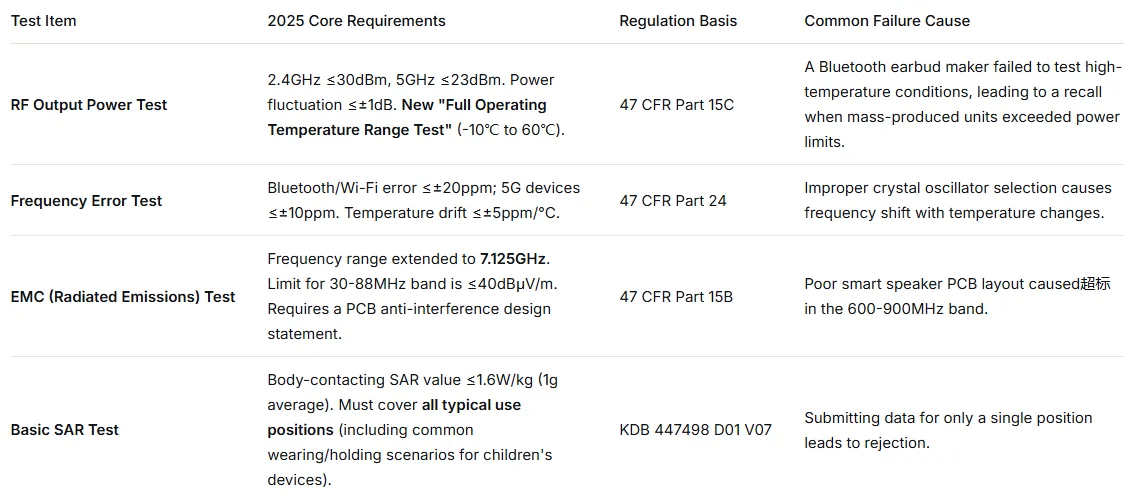
2. 2025 New Rule Additional Test Items
FCC 25-27 security rules and technical standard upgrades have Induce three core new tests, becoming key 2025 thresholds.
1.Cybersecurity Protocol Verification
·Requirement: 5G and network-critical devices (including routers, high-performance switches) must support TLS 1.3 encryption. Wi-Fi 6E/7 must enable WPA3 security. Must pass "protocol penetration testing" (verifying encryption link stability in complex networks). Older protocols like SSLv3 are prohibited.
·Regulation: 47 CFR Part 30, Part 15B supplements.
2.6GHz Band Specific Tests
·Requirement: Wi-Fi 6E/7 devices must complete: 1) Spectrum Mask test (band-edge spurious emissions ≤-27dBm/MHz). 2) Enhanced Dynamic Frequency Selection (DFS) test (must identify and avoid radar signals within 100ms, including Weather and Air Traffic Control radar types).
·Timeline Impact: Test cycle extends from ~2 days to ~4 days; cost increases by ~$1,500.
·Failure Case: A Wi-Fi 7 router manufacturer failed the 6GHz spurious emissions test due to a filter design flaw, delaying certification by 8 weeks.
3.Laboratory Eligibility Binding Verification
·Requirement: All test reports must include the testing laboratory's FCC 25-27 compliance proof, explicitly disclosing ownership of 5% or more. Labs cannot fall under the >10% foreign ownership prohibition.
·Regulation: FCC 25-27 Final Rules, Section 4.9.
3. Band-Specific Standard Test Items (Differentiated requirements; precise product matching)
Test focus varies significantly by frequency band. The 2025 FCC has strengthened interference control for higher bands.
·Sub-6G 5G Devices: Must pass Part 30 cybersecurity testing (verifying encryption module resistance). Requires carrier network access pre-verification proof.
·Drones (2.4/5.8GHz): New anti-interference test – must maintain signal stability in strong electromagnetic environments; RF link interruption ≤1s.
·Low-Power IoT Devices (LoRa/NB-IoT): Strengthened radiated emission control; 150kHz-30MHz conducted emission ≤73dBμV. Requires data correlating休眠 mode power consumption and radiation.
II. Core Products Requiring FCC ID Certification in 2025
Market articles often vaguely state "wireless devices need certification." In 2025, the FCC has clarified specific test boundaries for different products. Below are precise adaptation requirements for 5 high-frequency export product categories.
1. Smart Wearables (Smartwatches / Bands / Glasses)
·Core Tests: Multi-scenario SAR testing (including wearing, charging, etc.), Bluetooth RF performance, low-power radiation control.
·2025 Addition: Charging scenario SAR test (requires warning like "maintain ≥5cm from body when charging").
·Compliance Challenges: Children's models require testing for smaller-size wearing positions.
·Timeline: Standard model 3-4 weeks; models requiring multi-scenario tests add 3-5 business days.
2. Wi-Fi 6E/7 Routers (6GHz Band)
·Core Tests: 6GHz Spectrum Mask + Enhanced DFS testing, multi-band power balance testing, WPA3 protocol verification.
·New Rule Bind: Test reports must include laboratory ownership disclosure proof, otherwise invalid.
·Special Timeline: No expedited path. Plan 5 months ahead for peak seasons. Standard cycle 6-8 weeks.
·Cost Note: 6GHz Specialized Testing accounts for ~40% of total certification cost. Budget accordingly.
3. 5G Industrial Modules (Sub-6G)
·Core Tests: Part 30 cybersecurity test (TLS 1.3 verification), RF module and host integration testing, wide-temperature power stability testing.
·Industry Special: Requires industrial-scenario anti-interference proof (no performance degradation at -40℃ to 85℃).
·Common Pitfall: Using purchased modules without an integration declaration leads to classification as a "new device," requiring full re-testing.
·Tip: Prioritize pre-FCC-ID-certified modular chips to reduce certification costs by ~30%.
4. Low-Power IoT Devices (LoRa Sensors / Smart Locks)
·Core Tests: Low-power radiated emissions testing, wireless wake-up mode interference control.
·2025 Boundary Adjustment: Previously exempt LoRa devices (except those with frequency ≤9kHz) now require Part 15B radiated emissions testing.
·Optimization: Using π-filters can reduce conducted interference by 15-20dB, improving test pass rates.
5. Consumer Drones (2.4/5.8GHz)
·Core Tests: RF power + anti-interference testing, remote control link stability testing, operational Location SAR testing.
·New Rule: Requires flight zone frequency compliance proof to avoid interfering with Air Traffic Control signals.
·Failure Case: A drone maker failed anti-interference testing, requiring added signal shielding modules, increasing Mass production cost by 12%.
If you are preparing FCC ID certification for a specific product (e.g., a device with UWB functionality, a 5G medical terminal), please comment with the specific model and functions for a customized test checklist and compliance plan template. BLUEASIA: +86 13534225140 will provide professional certification consulting services.
Related News

