In 2025, preparing documentation and managing validity periods for FCC ID certification has entered a phase of "precise alignment with new rule specifics." Generalized checklists and vague validity statements can nullify all prior investment. This manual provides actionable compliance solutions across four dimensions: new rule prerequisite documents, device-specific checklists, three-tier validity management, and official verification tools, while clarifying commonly confused validity and reporting requirements.
Due to 2025 requirements like the laboratory security rules and new SAR standards, the documentation system has evolved into a closed loop of "Basic Identity – Core Technical – New Rule Specific – Compliance Declaration" documents. "New Rule Specific Documents" are the critical prerequisite for initiating certification and must strictly comply with the latest ownership disclosure requirement effective December 5.
Module 1: Basic Identity Documents (Entry Prerequisite – Validity Tightly Bound to Entity)
These are the foundational credentials for the FCC to identify the company and product. The key 2025 change centers on the application timeline for the Grantee Code, which must exactly match the applying company's legal information.
1.FCC FRN & Grantee Code
·Content: Free 10-digit FCC Registration Number (FRN); paid 3-5 digit Grantee Code ($60 fee).
·2025 Practical Timeline: Apply directly via the FCC CORES system. The Grantee Code is generated instantly upon payment. If using an agent, document verification may add 3-5 business days.
·Compliance Pitfall: The Grantee Code must match the applicant's legal entity. It cannot be borrowed. In 2025, three companies had submissions rejected due to a mismatch, causing over 7 business days of delay.
2.Corporate Entity & Agent Authorization Documents
·Content: Notarized English version of the business license; proof of authorized US/Canada representative (mandatory for companies without a North American entity).
·New Rule Requirement: The authorized representative assumes joint liability for document authenticity and cannot be an entity on the FCC's "Covered List."
Module 2: Core Technical Documents (Certification Core – Adapted to 2025 Technical Standards)
Technical documents directly determine the certification pass rate. Due to 2025 upgrades in SAR, VLP, and 5G security standards, multiple documents now require supplemental, specific data. There are no exemptions.
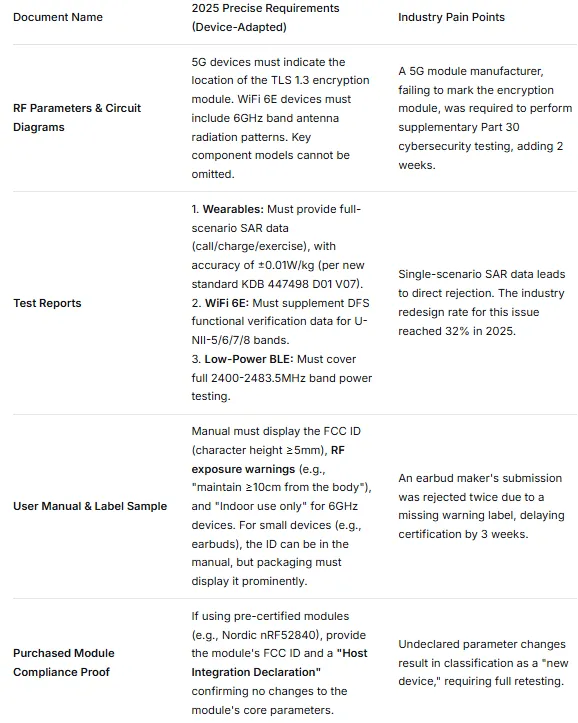
Module 3: New Rule Specific Documents (2025 Mandatory Prerequisite – Omission Invalidates Entire Submission)
The FCC 25-27 security rules (effective Sep 8, 2025) and the supplemental ownership disclosure requirement (by Dec 5) make these documents the certification "make-or-break line." Their validity must be verifiable through official channels.
1.Laboratory Compliance Dual Declaration
·Core Content: 1) The lab's Commitment Letter of Non-Control by Prohibited Entities, proving no ≥5% ownership by "Covered List" entities. 2) A list of all entities with ≥5% ownership/voting rights, submitted by the lab by December 5. Labs failing to submit risk revocation.
2.SAR Test Equipment Calibration Certificate
·Requirement: Calibration report from the lab, conforming to the new KDB 447498 D01 V07 standard, with a calibration Cycle not exceeding one year. SAR data from equipment not calibrated after March 31, 2025, is invalid.
Module 4: Compliance Declaration Documents (Legal Closure – Strengthens Consistency Commitment)
These documents are the company's legal warranty of product compliance. In 2025, the FCC strengthened the joint liability for "mass production and sample consistency."
1.Product Consistency Declaration
·Core Requirement: A commitment that mass-produced units are 100% identical to tested samples in core components (RF module, antenna, power supply, etc.). Must include a BOM comparison.
2.TCB Authorization Declaration
·Requirement: Clearly defines the TCB's Authorization scope and confirms the TCB has completed the FCC 25-27 qualification filing to avoid certification invalidation due to TCB ineligibility.
II. FCC ID Certification Validity Demystified
Market articles often claim "FCC ID is Lifetime valid." In reality, the 2025 FCC has built a dynamic management system of "Code – Test Report – Compliance Maintenance," with clear official distinctions for different change types. Differentiate between "Mandatory Timelines" and "Recommended Practice."
1. FCC ID Code: No Fixed Expiry, Bound to Compliance Status
·Official Rule: The code itself has no expiration date and can be used indefinitely if the product design is unchanged and meets current standards.
·2025 Core Limitation: Code validity is tightly bound to lab eligibility. If the original test lab is banned under FCC 25-27, US carriers may refuse network access even with a valid code. This requires re-testing at a compliant lab and updating the filing.
·Exception: 862-870MHz satellite communication devices require frequency compliance re-evaluation every 3 years.
2. Test Reports: Invalidated by Standard/Device Changes; No Unified Validity
-Standard-Driven Invalidation: Old reports require supplemental testing per new standards:
·Post-Mar 31, 2025, pre-2025 single-scenario SAR reports are completely invalid.
·Post-May 2025 VLP band expansion, old WiFi 6E reports need supplemental DFS data.
-Device Change Invalidation: Different change types have different processing methods and timelines.
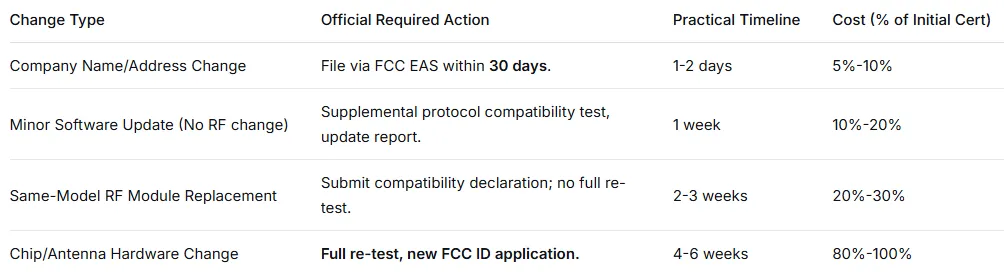
3. Compliance Maintenance: 10-Year Retention Mandatory; Reporting Varies
-Mandatory: All certification materials (test reports, diagrams, BOM, etc.) must be retained for at least 10 years. The FCC can audit anytime. A company was fined $50,000 in 2025 for insufficient retention.
-Differentiated Reporting:
·IoT devices, 6GHz WiFi 6E devices (key Regulation categories) must complete re-testing within 12 months of a standard update. Annual self-inspection reports are recommended.
·General consumer wireless devices have no mandatory annual report but should maintain an annual compliance log.
-Special Timeline: Change of corporate control (e.g., M&A) must be reported via FCC EAS within 60 days.
III. Device-Specific Documentation Checklist: 3 High-Frequency Products (Dec 2025 Practical Edition)
1. Smart Wearables (Smartwatch/Band)
·Core New Docs: Multi-scenario SAR report (incl. charging/exercise), SAR equipment calibration cert.
·Manual Specials: Must include scenario-specific warnings like "≥5cm from body when charging."
·Common Pitfall: Submitting only Regulation SAR data leads to ~40% rejection rate.
2. WiFi 6E Router (6GHz Band)
·Core New Docs: 6GHz full-band DFS functional test report; lab's Dec 5 ownership disclosure proof.
·Post-Cert Requirement: Must complete band compliance re-evaluation within 12 months of standard update.
·Timeline Note: No expedited path. Standard cycle 6-8 weeks. Plan 5 months ahead during peak seasons.
3. 5G Industrial Module (Sub-6G)
·Core New Docs: Part 30 cybersecurity test report (TLS 1.3 verification); RF module & host integration declaration.
·Special Requirement: Provide carrier pre-verification proof.
·Timeline Estimate: Full process 8-12 weeks. Cybersecurity test adds ~2 weeks.
If you are preparing FCC ID certification for a specific device, please provide the model, and I can supply a December-new-rule-adapted checklist and validity templates. BLUEASIA: +86 13534225140 will provide professional certification consulting services.
Related News