Handling US FCC certification for computers is an important step to enter the local market. Below, I will outline a latest certification guide as of 2025 to help you clearly understand the entire process.
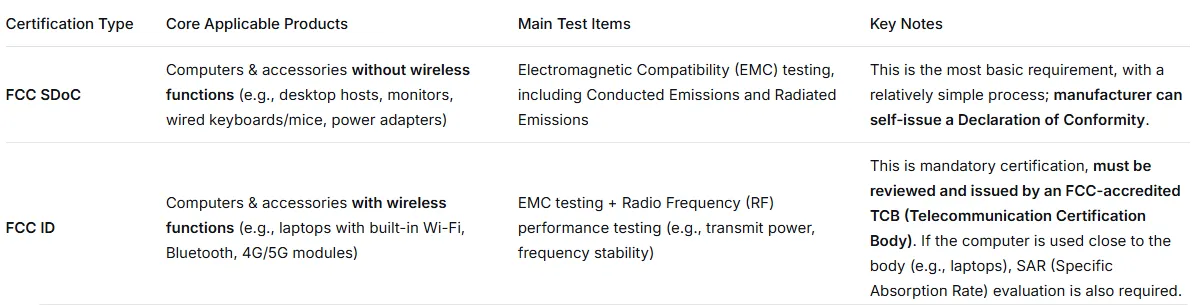
First, you need to determine which certification type applies based on the computer's specific configuration. Different types have vastly different processes, test items, and complexity.
2025 New Regulations & Important Changes:
Beyond the basic requirements above, some key adjustments in 2025 FCC certification rules require your special attention:
1.Laboratory Trustworthiness Review: This is the most significant change this year. The new FCC rule prohibits using laboratories associated with specific "excluded entities" for testing. This means when selecting a testing laboratory for your computer product, you must ensure it has passed the FCC's "Trustworthiness Review". Many Chinese laboratories are restricted under this new rule, potentially requiring you to turn to FCC-recognized labs in the US, Europe, or elsewhere, which may impact testing cost and timeline.
2.Technical Standards Upgrade:
-SAR Test Accuracy Improvement: Starting March 31, 2025, SAR testing accuracy requirements for wearable devices, phones, and other wireless products increased by 30%. If your computer is a 2-in-1 tablet or other form factor used close to the body, be aware of this change.
-Frequency Bands & Cybersecurity: Testing requirements have expanded for devices supporting new bands like Wi-Fi 6E. Also, some high-end communication devices like certain 5G equipment are required to meet stricter cybersecurity standards (e.g., support for TLS 1.3 encryption protocol).
FCC Certification Process & Key Materials:
1.Preparation & Technical File Compilation: This is the foundation. Key materials you need to prepare include:
-Technical Files: Product circuit diagrams, block diagrams, English user manual (must include compliance declaration).
-Registration Info: First-time FCC ID applicants need to register an **FRN (FCC Registration Number) and Grantee Code.
-Samples: Prepare at least 2-3 debug-ready samples.
2.Sample Submission & Testing: This is the core link of certification. You need to send computer samples to an FCC-recognized (and trustworthiness-reviewed) laboratory for the tests listed in the table.
3.Review & Certificate Issuance: After passing tests:
-FCC SDoC Path: Relatively simple; the manufacturer can self-issue a Declaration of Conformity (SDoC) and retain all technical files for potential audits.
-FCC ID Path: Must submit test reports and other materials to an FCC-accredited TCB (Telecommunication Certification Body) for review; upon approval, the TCB issues the FCC ID certificate. Starting 2025, some TCBs have implemented AI-assisted review, speeding up the process somewhat.
4.Marking & Market Compliance: After certification
-Marking Requirements: The product must be correctly marked. FCC SDoC products are advised to bear the FCC logo, while FCC ID products must clearly display the FCC ID number (format like: `2ABET-XX123`), recommended height not less than 5mm.
-US Responsible Party: The FCC ID applicant must designate a US-based company as the Responsible Party (U.S. Responsible Party), responsible for communication with the FCC.
-File Retention: All technical files and declarations of conformity must be retained for at least 10 years.
We hope this guide, incorporating the latest 2025 policies, helps you clearly plan the FCC certification path for your computer products. If you have more questions about selecting wireless modules or addressing specific testing challenges, BLUEASIA: +86 13534225140, will provide professional certification consulting services.
Related News