DAB+ certification is a mandatory market access requirement for digital audio broadcasting equipment entering international markets, covering core tests such as RF performance, audio decoding, and electromagnetic compatibility. This article details certification standards, processes, costs, and regional variations based on the latest 2025 regulations and industry practices, empowering businesses to achieve efficient compliance.
1.Certification Essence: DAB+ certification is a mandatory market access requirement ensuring stable signal reception in complex environments, supporting high-fidelity audio and emergency broadcasting functions to safeguard public safety.
2.Applicable Product Scope:
- Receiving Equipment: In-vehicle radios, portable radios, smart speakers.
-Transmitting Equipment: Broadcast transmitters, repeaters (requires additional high-power testing).
3.Technical Advantages: DAB+ employs the HE-AAC v2 audio codec to deliver CD-quality sound at low bitrates, supporting multi-channel surround sound (DAB Surround) and data services (e.g., traffic updates, emergency alerts).
II. Core Standards and Test Items for DAB+ Certification:
1. Global Standards:
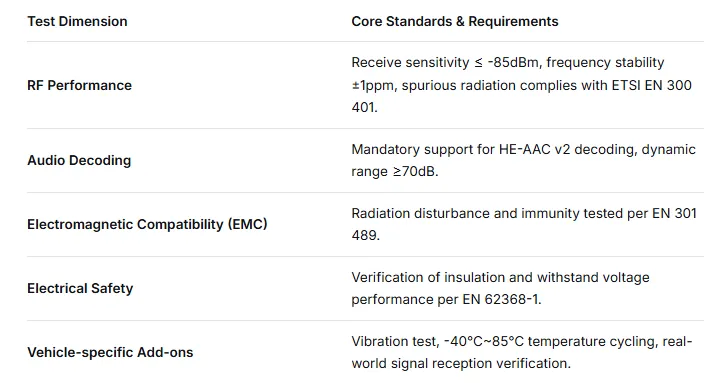
2. Region-Specific Requirements:
- EU:
- Must pass CE-RED certification per ETSI EN 300 401.
-New 2025 regulation: Adds IPv6 protocol testing (RFC8200). Non-pre-adapted products may face 1-2 week delays.
-Middle East:
-Saudi Arabia (SASO-2938): Mandatory Arabic interface support and Emergency Warning System (EWS). Certificate valid for 2 years.
- UAE (UAE.S5021:2018): Mandatory certification for in-vehicle devices; testing fees 15%-30% higher than EU.
- Southeast Asia:
- Thailand (NBTC BS 3004-2567): Mandatory effective 2025; requires Thai language configuration and user manual.
- Global New Regulations:
- DAB+ Automatic Safety Alert (ASA): Certification launches April 2025 based on ETSI TS 104 090. Passing allows use of the ASA logo.
III. DAB+ Certification Process & Cycle Optimization:
1. Full Process Breakdown:
- Preliminary Preparation (1-2 weeks):
Define target markets; prepare technical documentation (circuit diagrams, multilingual manuals), prototypes (2-3 units), and corporate credentials.
- Laboratory Testing (4-8 weeks):
- High failure rate stage (40% issues concentrated in RF/EMC).
- Core items: RF performance, audio decoding, EMC, in-vehicle environmental adaptation (if applicable).
- Remediation and Retesting (2-4 weeks):
Common issues include signal modulation errors and EMC interference exceeding limits. Retesting fees range from 30%-60% of the initial cost.
- Certification Review (3-6 weeks):
Authority reviews reports and issues a 3-year certificate (2 years for Saudi Arabia).
2. Cycle Optimization Strategies:
- Pre-testing: Conduct preliminary risk screening at authorized labs to prevent formal test failures.
- Modular Design: Reuse certified components (e.g., chips) to minimize redundant testing.
- Expedited Service: Pay 30%-50% expediting fee to reduce cycle time to 60% of standard duration.
IV. DAB+ Certification Cost Structure & Control Recommendations:
1. Base Fees:
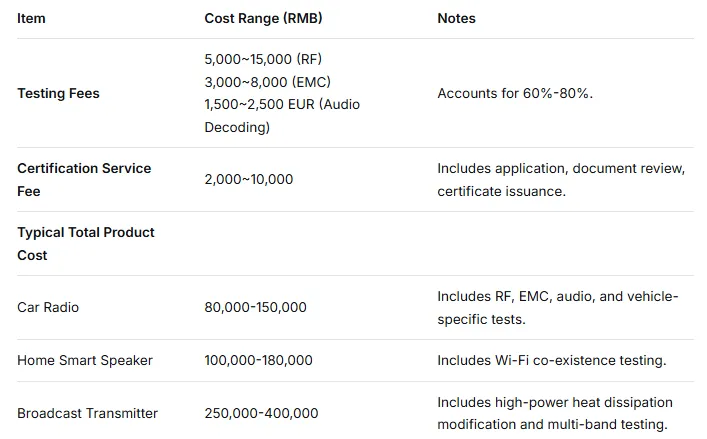
2. Hidden Costs:
- Recertification Fees: 30%-60% of initial testing costs.
- Multi-country certification surcharge: Additional RMB 20,000–60,000 for EU + Middle East certifications.
- Logo licensing fees: DAB+ logo requires licensing fees paid to chip suppliers (e.g., STMicroelectronics).
3. Cost-reduction recommendations:
- Targeted testing: Eliminate non-essential items based on target market standards (e.g., omit vibration testing for non-automotive devices).
- Multi-certification: Leverage international mutual recognition agreements (e.g., CE-RED covering select Middle Eastern requirements).
V. DAB+ Certificate Maintenance and Market Surveillance:
1. Validity and Maintenance:
- Most regions have a 3-year certificate validity (2 years in Saudi Arabia), requiring annual maintenance fees (10%-20% of the certificate cost).
- Hardware modifications (e.g., antenna replacement) necessitate recertification, costing 30%-70% of the initial fee.
2. Market Surveillance:
- Annual spot checks: Some authorities mandate periodic surveillance testing to ensure production consistency.
- Standard Updates: Retesting is required upon ETSI standard upgrades (e.g., adding HE-AAC v3).
VI. Key 2025 Regulations and Responses:
1. EU IPv6 Testing: New RFC8200 protocol testing requires compatibility interfaces reserved during design.
2. DAB+ Automatic Safety Alert (ASA):
- Launched by WorldDAB in April 2025; DTG Testing is the globally authorized partner.
- Certified devices may use the ASA logo to enhance consumer trust.
3. Mandatory Implementation in Thailand:
- New in-vehicle devices require mandatory certification starting October 31, 2025; other devices became mandatory on February 28, 2025.
DAB+ certification serves as the “technical passport” for globalizing digital audio devices. Enterprises must: - Plan proactively (e.g., embed IPv6, ASA functionality) - Precisely target markets (avoid generic designs) - Leverage pre-testing and modular strategies to control costs. As the DAB+ ecosystem expands into emergency broadcasting and IoT, early certification deployment will become key to market differentiation.
This information is current as of November 2025, based on the latest updates from official bodies such as ETSI and WorldDAB. For specific certification requirements, please refer to the guidance provided by authorized laboratories (e.g., Blue Asia Testing: +86 13534225140).
Related News

