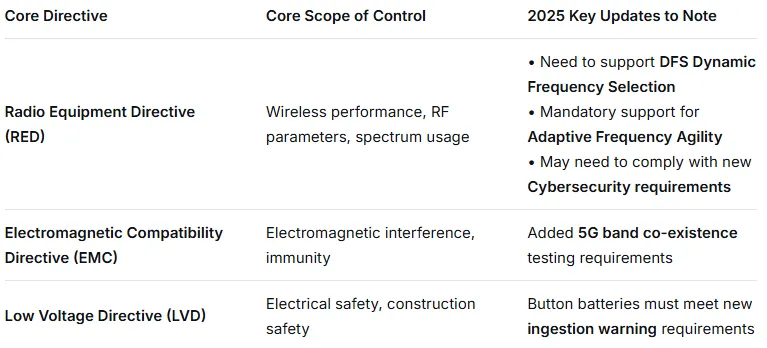
When applying for CE certification for a wireless keyboard, clarifying the EU directives it must follow is the first step to success. The table below summarizes the core directives and key update points as of 2025, helping you quickly grasp the essentials.
1.Preparation & Technical File Compilation: This is the foundation of all work. You need to prepare a comprehensive set of technical documents, typically including the product manual (in an EU official language), circuit schematics, bill of materials, user manual, etc. Starting August 1, 2025, for wireless devices with networking capabilities, mandatory cybersecurity assessment under the RED directive also requires special attention.
2.Sample Submission & Testing: This is the core part of certification. You need to send wireless keyboard samples to an EU-accredited laboratory for testing.
-RED Testing: Ensures RF parameter compliance, e.g., transmit power, frequency tolerance in the 2.4GHz band.
-EMC Testing: Verifies the keyboard does not generate excessive electromagnetic interference and is also immune to external interference.
-LVD Testing: Assesses the product's electrical safety, such as insulation resistance, electric strength.
3.Sign the Declaration of Conformity: After passing the tests, you need to draft and sign a Declaration of Conformity, which is the manufacturer's formal declaration that the product complies with EU regulations.
4.Affix the CE Marking: After completing all the above steps, the CE marking can be affixed to the product. The marking must be legible, indelible, and have a minimum height of 5mm.
Strategies for Optimizing Certification:
After understanding the process, some practical tips can help you complete the certification more smoothly.
-Modular Certification: If your keyboard uses a Bluetooth module that is already CE-RED certified, the certification process and test items for the final product can be greatly simplified, reducing the cycle by about 30%.
-Conduct Pre-testing: Before formal submission, conduct pre-testing through a laboratory to identify and resolve potential RF or electromagnetic compatibility issues in advance. This is an effective way to avoid additional costs and delays caused by test failures later.
-Series Product Handling: For series products, a strategy of main model + differential testing can be used, significantly saving the average certification cost per unit.
CE Certification Cycle:
For products with wireless functionality like wireless keyboards, CE certification typically takes 4 to 6 weeks. However, this time is not fixed. If the product requires modifications or expedited service is chosen, the cycle will be extended or shortened accordingly.
We hope this guide, incorporating the latest 2025 policies, helps you clearly plan the CE certification for your wireless keyboard. If you have more questions about selecting Bluetooth modules or addressing specific testing challenges, BLUEASIA: +86 13534225140, will provide professional certification consulting services.
Related News