Following Baidu's search quality content guidelines emphasizing "professional and trustworthy content" and "authentic and effective information," we have consolidated the mandatory certification new regulations released in recent years by Singapore's Infocomm Media Development Authority (IMDA). These new rules primarily focus on telecommunications equipment, application distribution, data centers, and emerging technologies, aiming to adapt to technological developments and ensure cybersecurity and user rights.
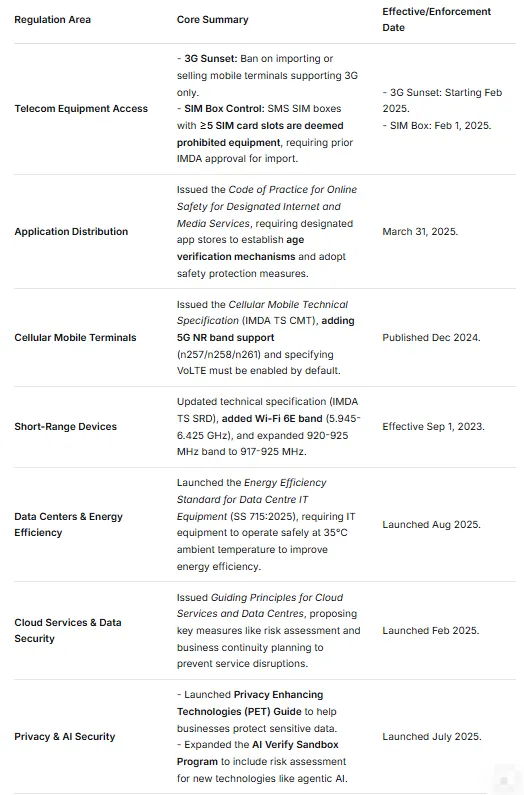
Detailed Interpretation & Impact Analysis of New Regulations:
Beyond the summaries in the table, understanding the background, specific requirements, and impact on relevant businesses is crucial.
1.Telecom Equipment Access Updates:
·3G Network Sunset & Terminal Ban: To keep pace with communication tech evolution, Singapore phased out its 3G network starting H2 2024. Supporting this, IMDA mandated that from February 2025, the import and sale of 3G-only mobile terminals cease completely. This means new mobile phones and other terminals must support 4G or 5G networks. Consumers will benefit from better voice calls (via VoLTE) and data experiences on more advanced networks.
·SMS SIM Box Control: This measure primarily targets the use of multi-SIM devices for bulk scam SMS broadcasting. The new regulation classifies SMS SIM boxes with 5 or more slots as prohibited telecommunications equipment. Note that importing SIM boxes with fewer than 5 slots also requires operation by a licensed dealer and sale only to companies registered in Singapore.
2.Application Distribution Service Safety Code:
IMDA's new rule aims to reduce user exposure (especially children) to harmful content via app stores.
·Core Requirements: Designated app stores (including Apple App Store, Google Play Store, Huawei AppGallery, etc.) must establish age verification mechanisms, set age rating standards, and enhance parental control features.
·Global Impact: This makes Singapore one of the first countries globally to mandate app age verification. Relevant app store platforms need to adjust their operations in Singapore accordingly.
3.Cellular Mobile Terminal & Short-Range Device Tech Standard Upgrades:
IMDA periodically updates its technical specs to ensure device compatibility, safety, and spectrum efficiency.
·Cellular Mobile Terminals (CMT): The latest spec adds support for 5G NR high-frequency bands (n257, n258, n261) and explicitly requires VoLTE (HD voice over 4G/5G) to be enabled by default, ensuring voice call quality.
·Short-Range Devices (SRD): Updates to the spec primarily reflect support for Wi-Fi 6E and broader IoT applications, adding bands like 5.945-6.425 GHz. This enables the development of higher bandwidth, lower latency wireless devices (e.g., next-gen routers, IoT products).
4.Data Centers, Cloud Services & Emerging Tech Governance:
IMDA is expanding its regulatory view from traditional telecom equipment to the underlying infrastructure and cutting-edge technologies supporting the digital economy.
·Data Center Energy Efficiency: The new standard SS 715:2025 requires data center IT equipment to operate safely and stably at higher ambient temperatures (35°C), aiming to significantly reduce cooling energy consumption and drive green transformation.
·Cloud Services & Business Resilience: While the Guiding Principles for Cloud Services and Data Centres is a non-mandatory advisory, it signals future legislative direction, emphasizing that cloud services and data centers must strengthen risk assessment and business continuity planning against increasing service disruption threats.
·Privacy & AI Security: IMDA's PET Guide helps companies perform data analysis and AI model training without exposing raw data. Simultaneously, expanding the AI Verify Sandbox provides a safe environment for testing and governing new AI architectures like "agentic AI."
Practical Advice for Businesses:
Facing IMDA's frequent regulatory updates, relevant companies can adopt the following strategies to ensure compliance:
1.Monitor Official Information Closely: Regularly check the official IMDA website and subscribe to its news feed for the most reliable first-hand information.
2.Conduct Compliance Inventory: Immediately review your product lines and services to determine if they fall under the new regulations. Pay special attention to import and sales bans for 3G terminals and multi-slot SIM boxes.
3.Proactively Adapt Products & Operations:
·For device manufacturers, ensure new products comply with the latest technical specs (e.g., support new 5G bands, enable VoLTE by default) during the design phase.
·For app distribution services, begin developing and integrating age verification systems meeting Singapore's requirements.
·All businesses should start focusing on data center energy efficiency improvements and cloud service resilience.
4.Utilize Policies & Sandboxes: Actively consider participating in IMDA's AI Verify Sandbox or PET Sandbox, which are not only pathways to compliance but also help companies gain a head start in emerging tech.
Summary:
Overall, Singapore IMDA's mandatory certification new regulations exhibit trends of expanding regulatory scope (hardware to software/services), forward-looking technical standards (5G, Wi-Fi 6E, AI), and **diversified legislative goals (balancing security, efficiency, environmental protection, and user protection).
This article is compiled based on IMDA official announcements, news releases, and authoritative interpretations, intended for forward-looking informational reference. As some regulations are still in transition or consultation phases, specific implementation details may change. Before taking significant commercial action, be sure to verify the latest information on the official IMDA website (https://www.imda.gov.sg).
We hope this overview aids your content creation and provides a practical guide for your readers. If you have deeper interest in specific areas of the new regulations, we can provide further information.
BLUEASIA: +86 13534225140, provides professional certification consulting services!
相关新闻

