To reduce electronic waste, improve consumer convenience and accelerate the green transition, the European Commission has formally adopted the ecodesign regulation Regulation (EU) 2025/2052. This regulation will be mandatory starting December 14, 2028, introducing new unified ecodesign requirements for external power supplies (EPS), general‑purpose portable battery chargers, wireless chargers, and USB cables sold on the EU market.
The regulation covers four clearly defined product categories:
(1) External Power Supplies (EPS)
Independent devices that convert AC voltage to DC or AC voltage to power or charge electronic equipment such as laptops, mobile phones, tablets, monitors, routers, etc. When used with battery‑powered end products, EPS are commonly referred to as chargers.
(2) General‑Purpose Portable Battery Chargers
Devices used to charge individual rechargeable batteries such as AA and AAA, and are not directly plugged into wall sockets.
(3) Wireless Chargers and Wireless Charging Pads
Devices that use electromagnetic fields to wirelessly charge mobile phones, smart watches and other devices. When used with an EPS, they are regarded as wireless charging pads.
(4) USB Type‑C Cables
Cables equipped with USB Type‑C connectors on both ends and compliant with official USB specifications.
2. Five Core Ecodesign Requirements (Mandatory from December 14, 2028)
(1) Energy Efficiency: Stricter Power Consumption and Efficiency Limits
·EPS no‑load power consumption: Depending on rated output power and type (single‑voltage / multi‑voltage, adaptive / non‑adaptive), no‑load power shall not exceed 0.075W – 0.5W.
·EPS efficiency: Full‑load, light‑load and average active efficiency must meet formula‑based limits, with special requirements for adaptive EPS.
·Wireless charger standby power consumption: DC input ≤ 0.5W; wireless charging pad (connected to EPS) AC input ≤ 0.8W.
(2) Power Output Performance: Ensuring Stable Power Supply
Limits are set on output voltage drop of EPS under load conditions to ensure stable charging performance.
(3) Interoperability: Toward “One Charger for All Devices”
·Default configuration of operable EPS: Operable EPS must be equipped with at least one USB Type‑C or USB PD (Power Delivery) port as standard, and must not have hardwired USB Type‑C cables.
·Universal charger marking: Compliant EPS must clearly display the “Universal Charger” logo on the nameplate, enclosure, packaging and user manual.
·Port power labeling: Each USB Type‑C / USB PD port must indicate its maximum output power with font height ≥ 2.56 mm.
(4) Surge Immunity: Improved Durability and Safety
Universal chargers must pass surge testing to ensure normal operation after abnormal voltage surges.
(5) Information and Labeling Requirements: Transparency and Consumer Right to Know
·Product nameplate: Must include key electrical parameters, energy efficiency information and the universal charger logo (where applicable).
·Website disclosure: Manufacturers must publicly disclose product compliance information free of charge on their official websites.
·Cable power marking: USB Type‑C cables must be marked with “60W” or “240W” on both connectors, complying with minimum font sizes (“60”/“240” ≥ 1.2 mm, “W” ≥ 0.6 mm).
3. Universal Charger Logo: Unified Identification for Easy Recognition
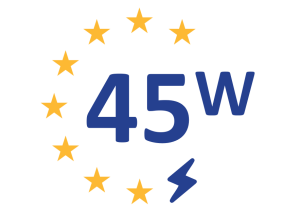
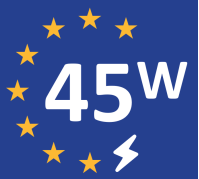
EPS meeting the definition of “universal charger” must use one of the following logos on the nameplate, enclosure, packaging and user manual:
·Positive color version: Suitable for any background color
·Negative color version: Suitable for dark backgrounds
·Monochrome version: Suitable for black‑and‑white or single‑color printing
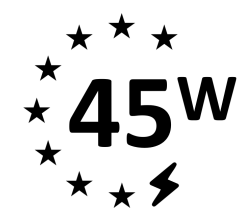
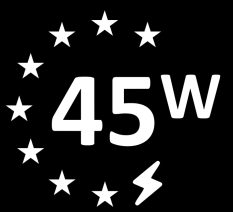
The power value in the logo represents the maximum output power of the USB Type‑C port.
Size requirements: Minimum height of 5 mm on the nameplate, and 7 mm in other locations.
4. Impacts on Enterprises and Recommended Actions
·Reassess product design: All relevant products must complete design updates by December 14, 2028 to meet requirements for energy efficiency, port configuration, labeling and more.
·Update technical documents and labeling: Ensure nameplates, packaging, user manuals and official website information comply with the new regulation.
·Plan testing and certification in advance: Cooperate with certification bodies early to conduct energy efficiency, interoperability and surge immunity tests.
·Check exemption clauses: Confirm whether your product falls under exempted categories (e.g., dedicated EPS for specific appliances) to avoid unnecessary design changes.
5. Summary
Regulation (EU) 2025/2052 is a key step for the EU in advancing green and digital transformation, with the goals to:
✅ Reduce electronic waste by eliminating redundant charging devices through universal charger design.
✅ Improve energy efficiency by lowering standby and no‑load power consumption.
✅ Enhance consumer experience by unifying ports and labeling for easier recognition and use.
Effective Date: December 14, 2028Enterprises should start compliance preparation as early as possible to maintain uninterrupted market access in the EU.
For consultation, contact BLUEASIA Testing & Certification Consultant: +86 13534225140 (Benson)
Related News

