For wireless keyboards planned for export to the EU, the 2025 CE certification rules have introduced some important changes, among which cybersecurity has transitioned from optional to mandatory.
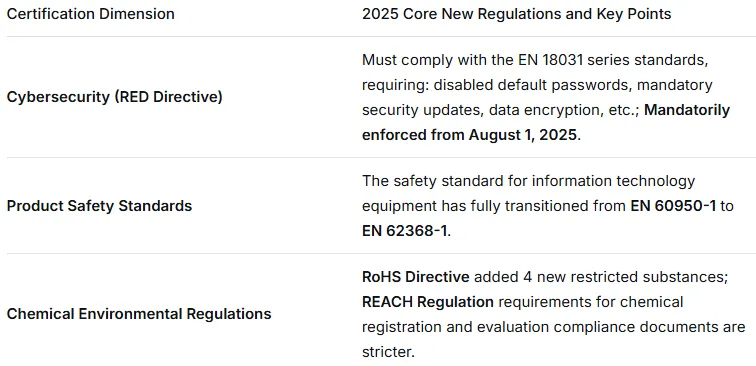
Detailed Explanation of New Cybersecurity Regulations: EN 18031
This new regulation most directly affects wireless keyboards with connectivity features. It stems from updates to the EU Radio Equipment Directive (RED), aiming to ensure devices meet basic requirements for network protection, personal data security, and fraud prevention.
Depending on whether your wireless keyboard handles sensitive data, the standards it needs to meet vary:
-EN 18031-1 (Network Protection): This is the baseline requirement for all wireless keyboards. Core points of the standard include:
·Disable Default Passwords: Must force users to change preset passwords upon first use.
·Security Update Mechanism: Must support security updates and prevent firmware rollback to older, insecure versions.
·Data Encryption: Sensitive data stored locally and transmitted must use strong encryption algorithms (e.g., AES-256).
-EN 18031-2 (Privacy Protection): If your keyboard involves processing personal data, health information, or is used by children (e.g., a keyboard with biometric features or a children's learning keyboard), then it must also meet the stricter privacy protection requirements of this standard.
Focus on Product Safety Standard Change: EN 62368-1
This regulation applies to all information technology equipment, both wired and wireless keyboards. The core difference between the old and new standards lies in the upgraded safety philosophy:
-Old Standard EN 60950-1: Based on the "hazard-prevention" principle, specifying specific test methods.
-New Standard EN 62368-1: Adopts the more advanced "energy source-based" philosophy, prescribing protective measures according to energy levels, making it more flexible and adaptable to new technologies.
For keyboard products, this shift means in practice:
-Electrical Safety: Introduces the concept of "accessible surface temperature" and requires single fault protection for USB-C interfaces.
-Mechanical Safety: Adds "energy transfer" assessment, e.g., assessing whether the actuation force of mechanical switches could cause finger injury.
-Fire-resistant Materials: Requirements for plastic flame retardancy are stricter.
-New Requirements: RGB lighting must comply with photobiological safety standards; built-in batteries require dual fault protection.
Core Steps in the Wireless Keyboard CE Certification Process:
Facing these new regulations, completing CE certification and affixing the mark for a wireless keyboard primarily involves the following key steps:
1.Confirm Applicable Directives and Standards
First, determine which directives the product needs to comply with. Wireless keyboards typically involve the RED Directive (wireless functionality), EMC Directive (electromagnetic compatibility), LVD Directive (electrical safety), and relevant chemical environmental directives.
2.Prepare Technical Documentation
This is the core of certification. Technical documentation should include: product specifications, circuit diagrams, risk assessment reports (especially for the new standard EN 62368-1), test reports, etc. Please note: According to EU law, technical documentation must be retained for at least 10 years after the product is discontinued.
3.Submit Samples for Testing
Send keyboard samples to an accredited laboratory for testing. In addition to routine Electromagnetic Compatibility (EMC), Radio Frequency (RF), and safety tests, cybersecurity assessment and energy efficiency testing are now also required based on product functionality.
4.Sign the Declaration of Conformity (DoC)
After passing the tests, the manufacturer or its authorized representative must sign an EU Declaration of Conformity, which is a legally binding document declaring the product conforms to all applicable EU regulations.
5.Affix the CE Mark
After completing all the above steps, the CE mark can be affixed to the product. The mark must be legible, indelible, and have a minimum height of 5mm.
Common Misunderstandings and Guidance:
Based on market feedback, here are the most common pitfalls companies fall into:
1.Confusing Certificate Types: The EU has repeatedly emphasized being wary of "voluntary certificates." Only certificates issued by an EU-designated Notified Body, or a Self-Declaration of Conformity completed by the manufacturer under applicable regulations, are valid proofs of conformity.
2.Overlooking the EU Authorized Representative: For products manufactured outside the EU, it is mandatory to appoint an Authorized Representative based within the EU, responsible for communication with market surveillance authorities and storing technical documentation.
3.Misunderstanding the Mark's Meaning: The CE mark is not a quality certification nor does it indicate the country of origin. It is solely a legal declaration by the manufacturer that the product conforms to the essential health, safety, and environmental protection requirements of the EU.
We hope this guide, incorporating the latest 2025 policies, helps you clearly plan the CE certification path for your wireless keyboard. If you can share more information about specific product features (e.g., voice support, built-in battery type), BLUEASIA: +86 13534225140, will provide professional certification consulting services.
Related News

