When planning to enter the Thai market, TISI Mandatory Certification costs are a key part of your export budget.
Unlike standardized fees, TISI certification costs vary depending on:
Product type and complexity
Testing requirements
Factory audit needs
Risk category
There is no fixed total price, but the following breakdown and estimates can help you plan a realistic budget for 2025.
Below is a simplified summary of the main cost components involved in TISI certification as of 2025:
Main Cost Items
Application review fee (official TISI fee)
Product testing fee (in a TISI-accredited lab)
Factory inspection / audit fee
Document translation and legalization
Local representative management fee
Sample shipping & customs clearance cost
Annual surveillance audit fee
Visual Reference:
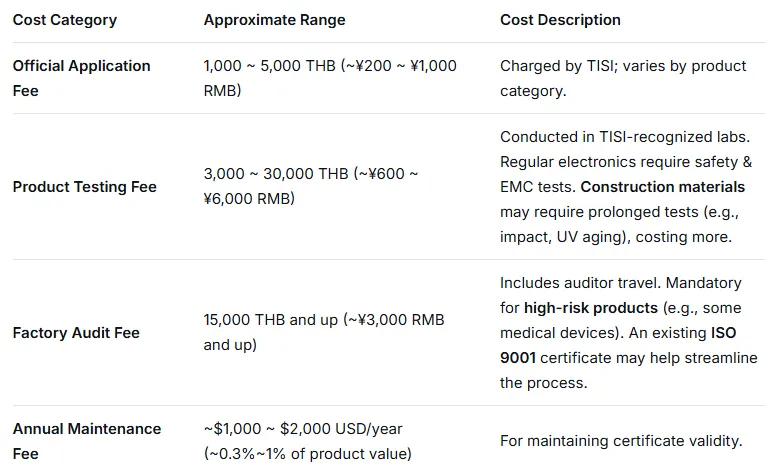
To help you estimate total expenses more accurately, here are average reference ranges (including testing and audit fees; official TISI application fee excluded):
Low-Risk Products (e.g., data cables, plugs, small accessories):
$550 – $2,100 USD (≈ ¥4,000 – ¥15,000 RMB)
High-Risk Products (e.g., air conditioners, large appliances, car tires):
$2,100 – $3,900 USD (≈ ¥15,000 – ¥28,000 RMB)
(Higher due to factory audits, complex testing, and safety validations.)
Tip: The total cost depends heavily on whether the product requires factory inspection, safety tests, or energy efficiency tests under the latest standards.
To optimize your certification spending and avoid unexpected fees, consider these best practices:
Identify your product’s risk level and certification model (e.g., long-term mark certification or batch certification).
Check your product’s Thai HS code or verify details via the TISI official website.
Early classification avoids unnecessary testing or audits.
If your product already has internationally recognized reports (e.g., CB Reports), you can reuse them during the TISI application.
However, Thai national difference testing is still mandatory.
Validity Period: 3 years
Maintenance: Requires annual surveillance audits, which may include:
Factory inspections
Market sampling tests
Re-certification: Design or component changes may require re-testing, costing 30%–70% of the original certification (≈ $165 – $2,700 USD depending on product).
Foreign manufacturers must appoint a Thai-registered company as the legal representative (certificate holder) to submit the application.
All technical documents must be in English or Thai, and product manuals/labels must contain Thai language content.
e-TISI Digital System:
Thailand has launched an electronic application system for faster submission and improved transparency.
Non-Compliance Penalties:
Selling uncertified products:
Fines up to 500,000 THB (≈ $13,900 USD)
Improper use of the TISI mark:
May result in daily fines until rectified
Product confiscation or import bans may apply in severe cases
| Product Type | Risk Level | Estimated Total Cost (USD) | Factory Audit Required | Typical Duration |
|---|---|---|---|---|
| USB Cables / Plugs | Low | $550 – $1,100 | ❌ No | 6–8 weeks |
| LED Lamps | Medium | $1,400 – $2,500 | ✅ Partial | 8–10 weeks |
| Air Conditioners / Refrigerators | High | $2,500 – $3,900 | ✅ Yes | 10–14 weeks |
| Car Tires | High | $2,800 – $3,500 | ✅ Yes | 12–14 weeks |
Q1: Can I skip TISI certification if my product is already certified in other countries?
A1: No. TISI is mandatory for specific products sold in Thailand, regardless of overseas approvals.
Q2: Can I apply without a local representative?
A2: No. You must have a Thai-registered company as your certificate holder.
Q3: Can TISI testing be done outside Thailand?
A3: Generally no. Testing must be conducted in TISI-accredited laboratories, though some international reports (e.g., CB) can be used for reference.
Q4: What is the penalty for selling uncertified products?
A4: Violations may result in fines up to 500,000 THB (~$13,900 USD), product confiscation, and daily penalties for misuse of the TISI mark.
Q5: How can I reduce certification costs?
A5: Use existing international reports, ensure complete documentation, and plan early to avoid extra testing or rework.
Successfully managing TISI certification costs requires:
✅ Early confirmation of product risk level and certification path
✅ Use of CB/IEC reports to reduce duplicate testing
✅ Selection of a qualified Thai local representative
✅ Ongoing management of certificate validity and audits
By planning strategically and understanding each cost component, manufacturers can enter the Thai market efficiently and avoid hidden expenses.
BLUEASIA Certification Consulting
Expert in ASEAN certifications — TISI (Thailand), SIRIM (Malaysia), SNI (Indonesia), IMDA (Singapore).
Email: king.guo@cblueasia.com
Phone: +86 13534225140
Related News

