Russia's FAC certification (Frequency Authorization Certification) is a mandatory certification for radio equipment sold and used in the Russian market, proving its compliance with Russian radio spectrum allocation and technical specifications.
With the implementation of multiple new regulations in 2025, the FAC certification system has undergone important changes in frequency bands, power limits, and certification processes.
FAC certification, i.e., the Russian Federal Service for Supervision of Communications, Information Technology and Mass Media (Roskomnadzor) Radio Spectrum Compliance Certification, is a mandatory market access system established under Russian Communications Law (Federal Law No. 126-FZ) and Roskomnadzor regulations.
Core Legal Requirements:
·Mandatory Certification: All wireless communication equipment sold or used in the Russian market must pass FAC certification.
·Sole Regulatory Authority: The Russian Federal Service for Supervision of Communications, Information Technology and Mass Media (Roskomnadzor) is responsible for supervision and implementation.
·Market Access Prerequisite: Products without FAC certification cannot be sold or used in the Russian market.
It is important to note that radio equipment needs to simultaneously meet EAC certification (TR CU 020/2011 EMC) and FAC certification, both of which are mandatory requirements.
2. FAC Certification Applicable Product Scope and Classification
FAC certification covers a wide range of wireless communication equipment, mainly including the following categories:
·Wireless Communication Equipment: Wi-Fi routers, Bluetooth devices, 4G/5G terminals, IoT devices (LoRa/NB-IoT), drone remote control systems, etc.
·Radio Transmitting Equipment: Walkie-talkies, radar, satellite communication terminals, etc.
·Telecommunication Network Equipment: Switches, routers, communication equipment, fax machines, and other products with wireless transmission functions.
Exceptions: Receiving-only equipment (e.g., standard radios) does not require FAC certification.
Product Classification:
Based on risk level, FAC certification classifies products into two categories:
·Class A: Commercial equipment (e.g., mobile phones, base stations), requiring comprehensive testing + factory audit.
·Class B: Low-risk equipment (e.g., Bluetooth earphones), applicable to simplified processes.
3. 2025 FAC Certification Standard Update Highlights
Russia's radio equipment certification system underwent a series of important updates in 2025, with specific points as follows:
Frequency Band and Power Adjustments
·5GHz Wi-Fi Power Increase: Effective March 1, 2025, the transmit power limit for Wi-Fi devices in the 5GHz and 6GHz bands has been increased from 100mW to 200mW.
·Clarified Frequency Bands: The 5150-5350MHz and 5650-6425MHz bands allow a maximum transmit power of 200mW.
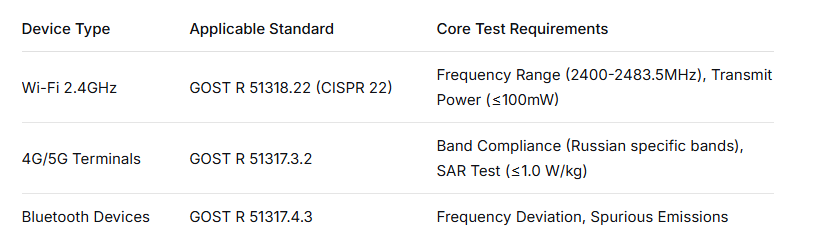
·2.4GHz Band Limit Unchanged: The 2400-2483.5MHz band still maintains a maximum transmit power of 100mW.
Technical Standard Updates
Different wireless technologies correspond to different testing standards. The following are the core testing requirements for main device types:
Localization Requirements
·Language Requirements: User manuals, labels, and software interfaces need to be provided in Russian.
·Voltage Requirements: Equipment needs to adapt to 220V, 50Hz; plugs need to comply with GOST 7396 standard (European standard 2-pin).
·Special Requirements: Phones and other devices used close to the body require SAR testing, with stricter requirements than the EU (≤1.0 W/kg).
4. FAC Certification Types and Validity Period
Starting in 2025, FAC certification further refined the certification types, allowing companies to choose the appropriate certification path based on product characteristics and market strategy.
-Declaration of Conformity (FAC Declaration)
·Applicable Scope: Client Devices, such as most wireless terminal products.
·Certificate Holder Requirement: Must be held by a local Russian company.
·Validity Period: Usually 3 years, some sources indicate it can reach 5-6 years, and some even mention up to 10 years.
-Certificate of Conformity (FAC Certificate)
·Applicable Scope: Master Devices/Base Stations/Switches/Routers (Master Devices) and high-risk equipment.
·Characteristics: Requires stricter testing and factory audits.
·Validity Period: 1-3 years (requires annual factory audits).
Selection Strategy:
For ordinary wireless terminal products, it is recommended to prioritize the Declaration of Conformity path, which can significantly reduce certification time and cost. For network infrastructure equipment, the Certificate of Conformity is more suitable.
5. FAC Certification Process and Timeline
The FAC certification process can be divided into several key stages. Below is a detailed process analysis:
Certification Process Steps
1.Determine Product Classification: Confirm whether the product belongs to Class A (high risk) or Class B (low risk).
2.Select Certification Body: Choose a Roskomnadzor-authorized body (e.g., Russian local laboratory or branch of an international organization in Russia).
3.Product Testing: Send samples to a Russian accredited laboratory for testing to obtain a test report (requires Russian or bilingual version).
4.Submit Application Documents: Submit complete application documents to the certification body, including test reports, technical passport, etc.
5.Review and Certification Issuance: After Roskomnadzor approval, the FAC certificate is issued.
Certification Timeline Analysis
·Class B Equipment: 8-12 weeks (using the Declaration of Conformity path, the process is relatively simple).
·Class A Equipment: 3-6 months (requires comprehensive testing and factory audit, the process is more complex).
It is worth noting that if the Declaration of Conformity path is selected and documents are well-prepared, some bodies can complete certification within 3-4 weeks.
6. FAC Certification Required Materials List (2025 Edition)
Applying for FAC certification requires preparing a series of technical documents and application materials. All documents must be in Russian or bilingual versions:
Core Application Materials
·Test Report: Issued by a Russian accredited laboratory (Russian version).
·Technical Passport: Includes circuit diagrams, RF parameters, user manual in Russian.
·Application Form: Roskomnadzor standard form (Form RFR-1).
·Quality Management System Documents: Manufacturer's ISO 9001 certificate (required for Class A equipment).
Additional Documents
·Enterprise Qualification Documents: Business license, tax registration certificate, and other relevant qualification proofs of the applicant company.
·Product Technical Documents: Product design drawings, circuit diagrams, instruction manuals, technical specifications, etc.
7. FAC Certification Cost Structure and Optimization Strategies
The cost of FAC certification varies significantly depending on the product type, test items, and certification body:
Cost Structure
·Testing Fee: Approximately $5,000-50,000 (depending on device complexity, e.g., 5G base station testing costs are higher).
·Certification Fee: Approximately $3,000-15,000 (including official fees).
·Factory Audit Fee: Class A equipment requires factory audits, incurring additional costs.
Optimization Strategies
·Utilize International Reports: Some international test reports (e.g., R&TTE reports issued by Intertek) can be recognized, reducing duplicate testing.
·Conduct Pre-testing: Perform "pre-scanning tests" before formal sample submission to identify and resolve potential issues early.
·Choose Certification Type Rationally: For eligible products, selecting the Declaration of Conformity path can significantly reduce costs.
8. Post-Certification Compliance Requirements
After obtaining FAC certification, companies still need to pay attention to the following matters:
Mark Usage Requirements
Products must be marked with the FAC certification mark and a unique identification number (e.g., "RU-RFR.XXXXX"), which must be permanently marked (e.g., on the nameplate or software interface).
Certificate Maintenance and Management
·Certificate Renewal: Submit a renewal application 3 months before expiration; if standards are updated, re-testing may be required.
·Market Surveillance: Roskomnadzor conducts spot checks on market products; non-compliant equipment may be confiscated or fined (up to 500,000 Rubles).
·Change Management: If the product design changes, it may be necessary to re-apply for certification or file for changes.
Although the Russia FAC certification process presents challenges, companies can complete the certification efficiently and compliantly by understanding the latest requirements, preparing in advance, and planning reasonably, thereby smoothly entering the Russian market. Special reminder to companies to pay attention to the new 5GHz/6GHz band regulations implemented from March 2025, which will directly affect the design and certification strategy of related products. BLUEASIA: +86 13534225140 will provide you with professional certification consulting services
相关新闻