In the EU market, the CE mark is not just a "passport" for wireless keyboards but also a technical bridge connecting to global trade. For manufacturers, understanding the regulatory dynamics behind it is a test of compliance and market foresight.
This article provides a comprehensive guide to wireless keyboard CE certification, covering the latest regulatory changes as of 2025, the certification process, key test items, and common pitfalls to help you efficiently and compliantly start your journey in the European market.
In 2025, the EU has made important updates to CE certification requirements, particularly for wireless devices. The table below summarizes the core changes most relevant to wireless keyboards:
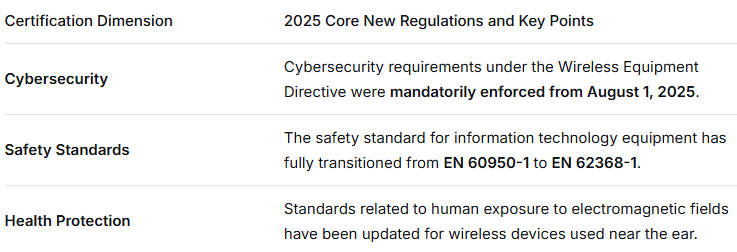
Beyond the points in the table, you need to pay special attention to the following changes:
-Cybersecurity is Now Mandatory: For devices with wireless connectivity, the cybersecurity clauses of the EU Radio Equipment Directive (RED) have officially taken effect. This means your wireless keyboard must have corresponding data protection capabilities, such as preventing unauthorized access and ensuring the security of personal data processing. These requirements can be assessed according to the harmonized standard EN 18031 series.
-Safety Standard Philosophy Revolution: The old standard EN 60950-1 was based on a "hazard-based" principle, while the new standard EN 62368-1 adopts a more advanced "hazard-based energy" philosophy. For keyboard products, the new standard has stricter or more flexible regulations in areas such as electrical safety, mechanical safety, and fire-resistant materials. For example, it introduces the concept of accessible surface temperature and requires single fault protection for USB-C interfaces and batteries.
-Stricter Chemical Environmental Requirements: The EU continues to upgrade controls on hazardous substances in products. The RoHS Directive has added 4 new restricted substances. Simultaneously, the REACH Regulation has stricter compliance documentation requirements for chemical registration and evaluation.
Wireless Keyboard CE Certification Process Explained:
1.Identify Applicable Directives and Standards
This is the starting point for certification. Wireless keyboards typically need to comply with the following three main directives:
·RED Directive: The core directive covering all radio equipment.
·EMC Directive: Ensures the product's electromagnetic compatibility, meaning it neither interferes with other devices nor is susceptible to interference from them.
·LVD Directive: Guarantees the electrical safety of the product.
Based on this, identify the corresponding harmonized standards, which provide detailed technical specifications for presuming conformity with the directive requirements.
2.Prepare Technical Documentation
This is the core of certification and the focus of market surveillance authorities' reviews. Technical documentation should include:
·Product specifications, user manuals
·Circuit schematics, PCB layout diagrams
·Bill of Materials [BOM], list of safety-critical components
·Risk assessment report (especially for the new standard EN 62368-1)
Please note: According to EU law, technical documentation must be updated in real-time with regulatory changes and retained for at least 10 years after the product is discontinued.
3.Submit Samples for Testing
Send wireless keyboard samples to an accredited laboratory for testing. Core test items include:
·EMC Testing: Such as conducted disturbances, radiated disturbances, electrostatic discharge immunity, etc.
·LVD Safety Testing: Such as clearances, electric strength, earth continuity resistance, fire hazards under abnormal operation conditions, etc.
·RF Testing: Such as transmit power, occupied channel bandwidth, spurious emissions, etc.
·Health Assessment (SAR): Assesses the potential impact of wireless devices on human health. For devices like wireless keyboards that are not typically used close to the head for long periods, an assessment may be needed to determine if SAR testing is exempt.
4.Review and Certificate Issuance
After passing the tests, the laboratory will issue a test report. For routine cases, the manufacturer can issue a self-declaration based on this report. However, if the product involves specific cybersecurity requirements (e.g., handles private data or monetary transactions) or uses a third-party system (e.g., Windows), a Notified Body (NB) designated by the EU must be involved for conformity assessment.
5.Sign the Declaration of Conformity and Affix the CE Mark
This is the final step and the manufacturer's formal declaration that the product complies with EU regulations. Upon completion, the CE mark can be affixed to the product. The mark must be legible, indelible, and have a minimum height of 5mm.
Common Misunderstandings and Guidance:
Based on market feedback, here are the most common pitfalls companies fall into:
1.Confusing Certificate Types: The EU has repeatedly emphasized being wary of "voluntary certificates." Only certificates issued by an EU-designated Notified Body, or a Self-Declaration of Conformity completed by the manufacturer under applicable regulations, are valid proofs of conformity.
2.Overlooking the EU Authorized Representative: For products manufactured outside the EU, it is mandatory to appoint an Authorized Representative based within the EU, responsible for communication with market surveillance authorities and storing technical documentation.
3.Misunderstanding the Mark's Meaning: The CE mark is not a quality certification nor does it indicate the country of origin. It is solely a legal declaration by the manufacturer that the product conforms to the essential health, safety, and environmental protection requirements of the EU.
We hope this guide, incorporating the latest 2025 policies, helps you clearly plan the CE certification path for your wireless keyboard. If you can share more information about specific product features (e.g., voice support, built-in battery type), BLUEASIA: +86 13534225140, will provide professional certification consulting services.