In 2025, manufacturers planning to launch Bluetooth products in the US market need to closely follow a series of BQB certifications implemented by the Bluetooth SIG. To help you clearly and efficiently grasp the latest dynamics, this guide will systematically analyze the applicable products, test items, and those key changes you must understand.
All products integrating Bluetooth functionality must pass BQB certification before market launch. This is not only a guarantee of technical compliance but also a mandatory requirement for the legal use of Bluetooth trademarks and market access.
According to Bluetooth SIG specifications and industry practice, BQB certification applies to all electronic products integrating Bluetooth functionality, mainly categorized as follows:
1.Consumer Electronics: This is the most familiar area.
·Audio Devices: Such as Bluetooth headsets (TWS earphones), portable speakers, smart speakers (need to support Bluetooth audio transmission profile A2DP).
·Mobile Terminals: Smartphones, tablets, laptops (need to support Bluetooth data transfer or peripheral connection).
·Wearable Devices: Smartwatches, fitness bands (need to support Bluetooth for syncing health data or notifications).
2.Automotive & IoT Devices: This is a rapidly growing area for Bluetooth technology.
·Automotive Electronics: In-vehicle infotainment systems, navigators, OBD diagnostic devices (need to connect to phones or sensors via Bluetooth).
·Smart Home: Such as smart bulbs, door locks, thermostats (relying on Bluetooth Mesh or BLE) and smart ACs, refrigerators supporting Bluetooth provisioning, etc.
·Industrial Equipment: Bluetooth sensors, industrial controllers (need to meet anti-interference requirements).
3.Computer Peripherals & Accessories:
·Input Devices: Bluetooth keyboards, mice, trackpads (need to pass HID profile testing).
·Data Transfer Devices: Bluetooth adapters, print modules.
·Gaming Devices: Bluetooth game controllers, VR controllers (require low-latency verification).
4.Special Scenario Exemptions:
It is important to note that in the following two special cases, full BQB certification may not be required:
·Module-Only Products: If only selling the Bluetooth module itself (not integrated into an end product), the module itself needs certification, but downstream finished products can be "listed" based on the module certification.
·OEM Products: When using a certified finished product for OEM sales, if the brand remains unchanged, re-certification is not required.
BQB Certification Core Test Items:
BQB certification verifies product compliance with Bluetooth core specifications through a series of tests, mainly including the following three categories:
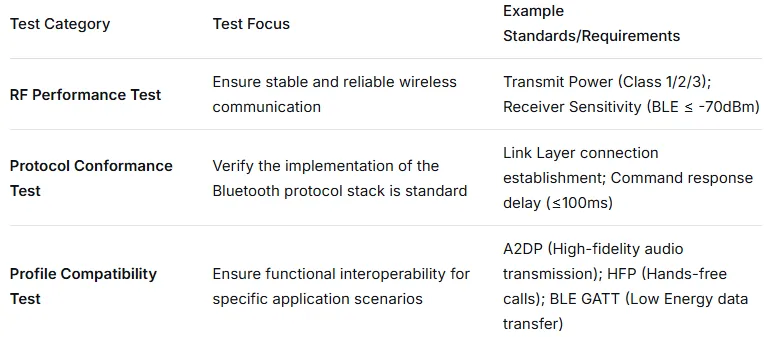
BQB Certification Important Reminders:
When conducting BQB certification, there are several key points you need to pay special attention to:
1.Necessity of Certification: Legally, BQB certification itself is not mandated by US federal law but is a de facto market access standard. If you use the Bluetooth trademark (Bluetooth® word mark or logo) on your product or claim Bluetooth functionality support, you must pass BQB certification; otherwise, it constitutes trademark infringement, facing legal action from SIG. Furthermore, major e-commerce platforms like Amazon, Walmart also mandate Bluetooth products to provide the certification listing ID for listing.
2.Marking & Maintenance: After certification, the product must be marked with the Bluetooth logo and the DN code (replacing the old QDID), with a logo height requirement of ≥8mm. Although the three-year re-assessment is cancelled, if the product undergoes hardware changes (e.g., changing antenna, chip) or adds new Bluetooth features, re-certification or a change notification is still required.
We hope this guide helps you better plan and complete BQB certification. If you can share the specific product type (e.g., Bluetooth headset, smart home device, or automotive module), BLUEASIA: +86 13534225140, will provide professional certification consulting services.

