Successfully selling electronic products in the United States requires navigating the essential step of obtaining FCC ID certification. It's not just a legal mandate from the Federal Communications Commission (FCC) but also a compulsory entry requirement for major e-commerce platforms like Amazon. Many companies find their traditional certification experience no longer fully applicable in 2025 due to profound policy-level changes.
FCC certification is a mandatory US market access system ensuring electronic products meet electromagnetic compatibility, radio frequency safety, and other requirements. It bifurcates based on wireless capability:
-FCC ID (Certification):Applies to all intentional radiators – devices designed to emit RF energy. This is the strictest, mandatory path. Examples: smartphones, Wi-Fi routers, Bluetooth headsets, wearables, IoT modules.
-FCC SDoC (Supplier’s Declaration of Conformity): For ordinary non-wireless electronics (most appliances, IT equipment, lighting). Simpler process. (This article focuses on FCC ID).
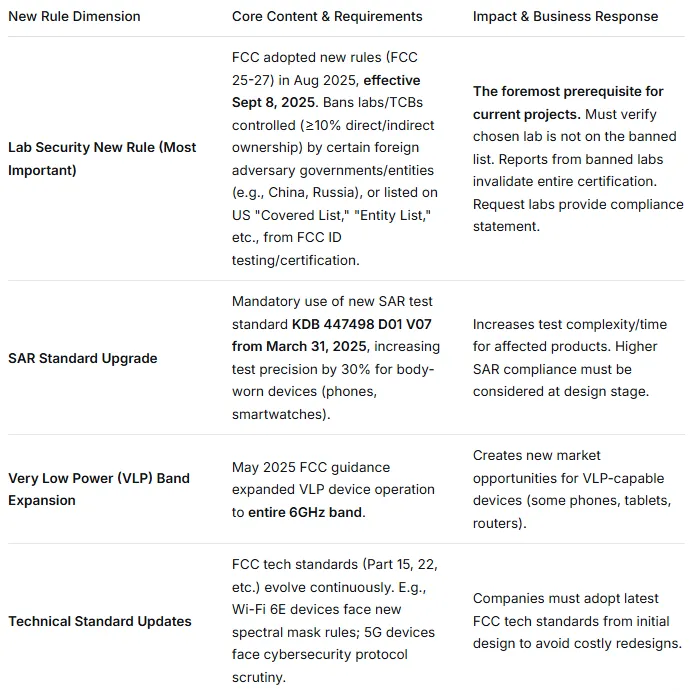
II. 2025 Core New Rules: Lab Ban & Standard Updates
2025 saw the most significant FCC ID rule changes in years, directly impacting testing strategy.
III. Complete FCC ID Process Breakdown (2025 Version)
1.Preparation (~1-2 weeks):
-Register for a free 10-digit FRN on FCC website.
-Apply for a permanent 3-5 digit Grantee Code (~$60 USD) – becomes prefix of your FCC ID.
-Prepare technical docs: block diagram, schematics, EN user manual (with FCC statements), product photos.
2.Sample Testing (Core, ~2-6 weeks):
-Choose Lab: Per 2025 rules, send samples to an FCC-recognized lab complying with the new security rules. Provide 2-3 "fixed" samples.
-Core Tests:RF Performance (power, frequency, bandwidth per e.g., FCC Part 15C/E). EMC (conducted/radiated emissions). SAR (for devices used ≤20cm from body).
3.Report Submission & TCB Review (~3-8 weeks):
-Lab submits test report and docs to an FCC-accredited Telecommunication Certification Body (TCB).
-Appoint a US Agent:** Mandatory – a US-based responsible party for FCC communications.
4.Obtain Certificate & Labeling:
-TCB issues certificate with unique FCC ID. Note: FCC ID-certified products must not use the traditional FCC logo. They must be permanently labeled with the FCC ID (format: XXXX-XXXXXXX).
5.Post-Certification Maintenance:
-No official fixed expiry, but any hardware/software/RF-affecting change may require re-testing/update.
-Maintain all technical files & test reports for at least 10 years for FCC market spot check.
IV. Cost & Timeline Estimate
Cost Composition:
-Testing Fees: Core (60%-80%). Simple single-band Bluetooth: ~6,000-10,000 RMB. Complex smartphone/Wi-Fi 6E router: 20,000-50,000+ RMB.
-TCB Review/Application Fee:~2,000-5,000 RMB.
-Additional: Expedited service (+20-30% fee), document handling, etc.
General Timeline:
-Smooth case: 4-8 weeks from testing start to certificate.
-Test failure and rectification is the biggest variable, potentially adding weeks.
V. Key 2025 Actionable Advice for Exporters
1.New Rule #1: Vet Your Lab First: Before any testing, conduct due diligence on the lab to ensure full compliance with the Sept 2025 "trusted lab" rules. This is foundational.
2.Leverage "Pre-testing" or "GAP Analysis": Identify and fix ~80% of potential design issues before formal submission, optimizing cost and timeline control.
3.Use Pre-certified RF Modules: If your product integrates an RF module (Wi-Fi/Bluetooth) with its own FCC ID, you can often seek exemption for that module's RF tests, simplifying and reducing cost for the host device.
4.Bake Compliance into Design: Incorporate latest FCC requirements (SAR limits, new band rules) as design inputs from the start, avoiding late-stage redesigns.
VI. Conclusion:
FCC ID certification in 2025 entered a new phase characterized by "security vetting" and "standard escalation." Success key has shifted from mere technical Meet the standards to proactive management of compliance chain risks—especially regarding the testing laboratory.
For businesses, compliance must transform from a passive, end-stage "testing box" to an active strategy run through the entire product lifecycle from planning to market. Only by deeply understanding and actively adapting to these new rules can you ensure unimpeded access to the US market.
BLUEASIA Tech: +86 13534225140 provides professional certification consulting services.
Related News